Wednesday, February 8, 2006

Turner City

If Turner Construction built its own city...

:: They'd call it Turner City,
:: There'd be one building per block, with lots of grass,
:: Water would flow at right angles,
:: People would live in danger of the giant bouncing ball, and
:: It would be very, very bland.

Missing image - turnercity.jpg

Follow the bouncing ball to see what lovely things Turner has built in your town, like the University Center in downtown Chicago.

Missing image - turnercity2.jpg

Tuesday, February 7, 2006

Foreclosures Rise / More Defaults Expected

KnowledgePlex is reporting there will be a Flood of Mortgage Defaults in the Gulf Coast as Grace Periods Expire.
Foreclosures.com, a California based investment advisory firm and nationwide publisher of distressed property information reported today that a flood of mortgage defaults could be expected in the storm ravaged Gulf Coast region. 90-day grace periods extended by many mortgage lenders expired in December.

"Borrowers could still negotiate workout solutions on a case by case basis," said ForeclosureS.com president Alexis McGee, "but they had to do it before December 1st." She added that many properties are simply gone, and that about 850,000 structures were completely destroyed or so badly damaged as to be uninhabitable.

"The impact of the hurricanes last year will distort the Gulf Coast housing market for some time," Ms. McGee said. She added that both loan originators and the secondary mortgage market were trying to accommodate borrowers suffering from hurricane related financial problems. "For example," she pointed out, "delinquencies of both mortgages and consumer debt are not being reported to credit bureaus, nor are hurricane related foreclosures."

She went on to say that the Gulf Coast housing market was strong even as defaults increase as people with insurance settlements find replacement housing, while those without insurance face foreclosure.

Ms. McGee also warned that scam artists were already at work in the devastated region. "Crooked adjusters are urging people to file bogus insurance claims for a share of the proceeds. Inexperienced and unlicensed contractors are preying on people with damaged homes, demanding money up front and then disappearing without doing the work. There have also been some suspicious house fires in cases where there was fire insurance but no flood insurance."

Foreclosures.com has been publishing foreclosure lists and assisting investors since 1992. The company expanded its foreclosure list coverage to nationwide on November 15, 2005. Ms. McGee said that they now have over 700,000 listings of distressed property in more than 900 counties across the U.S. on their website www.foreclosures.com.

"We teach our investor clients how to create win-win scenarios that benefit both the distressed owner and investor," Ms. McGee said. "The homeowner conserves some equity for a new start, and the investor realizes a reasonable profit on resale of the home. That's much better than seeing the owner lose everything in a foreclosure auction."
According to RealtyTrac's US Foreclosure Market Report National Foreclosures Increased in Every Quarter of 2005.
RealtyTrac� the leading online marketplace for foreclosure properties, today released year-end data from its 2005 U.S. Foreclosure Market Report, which showed that 846,982 properties nationwide entered some stage of foreclosure in 2005, and a 25 percent increase in the number of new foreclosures from the first quarter to the fourth quarter.

RealtyTrac publishes the largest national database of pre-foreclosure and foreclosure properties, with more than 550,000 properties in nearly 2,000 counties across the country, and is the foreclosure data provider to MSN House & Home, Yahoo! Real Estate, AOL Real Estate and HomeGain.com.

�Overall U.S. foreclosure numbers climbed steadily over the course of the year, with more new foreclosures reported in every quarter,� said James J. Saccacio, chief executive officer of RealtyTrac. �This trend appears to be moving the real estate foreclosure market back to its historic levels.�

Saccacio noted that the number of 2005 foreclosures needed to be kept in context. �Even with almost 850,000 properties entering some stage of foreclosure across the country over the course of the year, this represents less than 1 percent of all U.S. households. And the increase in U.S. foreclosures from Q3 to Q4 was just below 5 percent.�

Report Highlights

� Despite a 29 percent decrease in new foreclosures from the first quarter to the fourth quarter, Florida documented the nation�s highest foreclosure rate and accounted for more than 14 percent of the nation�s new foreclosures in 2005. The state reported 121,843 properties entering some stage of foreclosure � 1.67 percent of the state�s households.

� New foreclosures in Colorado decreased 4 percent from the first quarter to the fourth quarter, but the state�s annual foreclosure rate ranked second highest nationwide thanks to consistently high foreclosure numbers throughout the year. A total of 29,630 Colorado properties entered some stage of foreclosure in 2005 � 1.62 percent of the state�s households.

� 1.5 percent of Utah households entered some stage of foreclosure in 2005, the nation�s third highest annual foreclosure rate. The state reported 11,536 properties entering some stage of foreclosure during the year, but new foreclosures dropped 27 percent from the first quarter to the fourth quarter.

� New foreclosures in Texas increased 54 percent from the first quarter to the fourth quarter, and the state documented the nation�s fourth highest annual foreclosure rate. A total of 115,643 Texas properties entered some stage of foreclosure in 2005 � 1.44 percent of the state�s households and more than 13 percent of the nation�s new foreclosures in 2005.

� Other states with foreclosure rates ranking among the 10 highest nationwide were Georgia, Arizona, Indiana, New Jersey, Ohio and Tennessee. All of these state documented annual foreclosure rates of at least 1 percent of total households and reported new foreclosures increasing from the first quarter to the fourth quarter

� Although their foreclosure rates ranked below the nation�s 10 highest, California, Illinois, New York and Michigan were among the 10 states reporting the most new foreclosures in 2005. California reported 61,563 properties entering some stage of foreclosure, and new foreclosures increased 16 percent from the first quarter to the fourth quarter. Illinois reported 46,723 properties entering some stage of foreclosure, and new foreclosures decreased 14 percent from the first quarter to the fourth quarter. New York reported 37,068 properties entering some stage of foreclosure, and the state reported more than twice as many new foreclosures in the fourth quarter as in the first quarter.

�Over the past few years, we�ve seen historically low mortgage rates, consistently escalating home prices and steady, strong employment,� Saccacio said. �This has translated into relatively low levels of foreclosure properties � particularly bank-owned properties. With interest rates rising and an apparent slowing of property valuations in most markets, we�ll be watching closely to see if there�s a material effect on the number of foreclosures in 2006.�
Click on the above link for a nice chart of state by state foreclosures.
I found the following snip rather interesting.

"Even with almost 850,000 properties entering some stage of foreclosure across the country over the course of the year, this represents less than 1 percent of all U.S. households. And the increase in U.S. foreclosures from Q3 to Q4 was just below 5 percent."

Is that supposed to make people happy?

1% may sound low but that means every 100th house you see will have been foreclosed in 2005. 2006 will be much worse. The bubble states have not even turned yet.

Frorida had a decrease in foreclosures of 39% and California only rose 15%. Despite a 29 percent decrease in new foreclosures from the first quarter to the fourth quarter, Florida documented the nation�s highest foreclosure rate and accounted for more than 14 percent of the nation�s new foreclosures in 2005. The state reported 121,843 properties entering some stage of foreclosure � 1.67 percent of the state�s households.

When there are mass defaults on Florida condos I expect those numbers to skyrocket. More interesting is the claim I keep hearing that Florida's economy is strong and job growth is vibrant. If the Florida economy is so vibrant why is it leading the nation in foreclosures? Where is the job growth anyway? Construction? What happens when construction heads south? It will not take much to reach the 2% level in foreclosures. If that happens, and I expect it to, 1 out of every 50 homes in Florida will go into foreclosure in 2006. Does that sound like a lot of foreclosures? It does to me.

On that note a telepathic question just came in:
Mish how are those homebuilders doing?

Good question Lets take a look at Toll Brothers.
Luxury builder TOLL Brothers Inc. reported a steep 29% decline in orders in its fiscal first quarter that ended Jan. 31 and slashed its delivery projections for 2006.

Toll tweaks forecast downward again.
Toll Brothers Inc. said Tuesday that selling houses during its fiscal first quarter was more "difficult" than a year ago and lowered its sales forecast for fiscal 2006.

It was the second time since November that the Horsham, Pa., residential developer reduced its forecast for this fiscal year and could be another indicator that the nation's housing market is losing steam after being red hot the last five years.

Toll, which was reporting preliminary results for the quarter, attributed the decline to problems finishing houses as well as a cooling of demand. The company said there have been delays in receiving certificates of occupancy, construction inspections and utility hook-ups.

Signed contracts were down 21 percent to $1.14 billion compared with the same period a year ago. Demand for new housing in a number of the markets in which it builds is softening.
Toll attributed the weakness to "Finishing Problems".
Did Toll all of a sudden forget how to finish houses and get occupancy permits and construction inspections? It would seem to me with declines in housing everywhere that there should be fewer problems getting timely inspections.

Meanwhile, things are doing so well for Centex now that they have increased their discount to $150,000.

How long will it be before we see the first $200,000 reduction for Centex? How many people that paid $150,000-$200,000 too much just a few short months ago will be tempted to walk away?

Remember that the uptick in foreclosures has just started. Now is not the time to be thinking about bottom fishing. It's a long, long way down from here for the bubble areas.

Mike Shedlock / Mish
http://globaleconomicanalysis.blogspot.com/

Tadashi Kawamata

Thanks to an anonymous tipster on an old post, I can finally put a name with a piece of art. In that post, I mentioned that an artwork in Texas reminded me of "a now-forgotten (to me) installation where wood members wrapped a street corner in a European (Japanese?) city." Well, it turns out that it was actually in Canada, the "Toronto Project" from 1989 by Tadashi Kawamata.

Missing image - kawamata.jpg

I can't recall when I first saw a photograph of that installation, but I do remember it striking a chord in me, its construction, its dynamics, its relationship to the staid neighbors. Coincidentally, the artist's web site indicates, "at 27 January 2006, this website is renewed for its almost first time since starting!" So go ahead and browse through the projects, many of which - to this day - use dimensional lumber and other wooden objects in interesting ways.

Monday, February 6, 2006

Monday, Monday

My weekly page update:
missing image - faraday2sm.jpg
Faraday House in Bern, Switzerland by Thomas Jomini Architecture.

The updated book feature is Geography of Home, by Akiko Busch.

Some unrelated links for your enjoyment:
PartIV
"Architectural antifreeze...for when architecture gets a little too cool for comfort." (added to sidebar under blogs::architecture)

PRADE
"The blog for the untrained but discriminating design eye...[that] covers anything from architecture and interior design to sneakers, gadgets, furniture, clothing, culture, media, movies, magazines, and museums." (added to sidebar under blogs::design+technology)

Arkadia
A thorough listing of architectural magazines and E-zines.
Tuesday update: Be sure to check out Norman (PartIV) Blogster's funny post Architect or Bond villain?

Sunday, February 5, 2006

Arco-rleans?

According to the scottsdale republic, "Shortly before Hurricane Katrina struck New Orleans and other Gulf cities last summer, Scottsdale architect Paolo Soleri completed Solare, an urban design for a Chinese city," and "Soleri, founder of the experimental community Arcosanti, has reworked Solare as a solution for New Orleans' devastated areas."

I've written about Soleri and Arcosanti in the past, and I find his ideas especially relevant today, even though he's been pursuing his Arcology in the desert for over thirty years. While it may be a bit too radical or wacky for many people, the ideas of "complexification and miniaturization of the city [enabling] radical conservation of land, energy and resources" could be an appropriate response to the devastation on the Gulf Coast.

But this raises questions about NOLA's - and the greater damaged area's - reconstruction: Should developers lead the effort? Or should a comprehensive plan (be it New Urbanism or Arcology) be the driving force? Where does sustainability fall into the rebuilding? Are visionary designs as important as the immediate need for housing? Who's going to pay for all this? And what about the levees? And on and on.

I'll admit I haven't paid much attention to the CNU's efforts on rebuilding (for those interested, John Massengale's blog contains a wealth of information on the effort). Their role has been the most direct response to the disaster and perhaps will have the greatest impact on the area. It appears that the New Urbanist team reports are extremely thorough and extensive, working from regional planning down to a pattern book for architectural details. But what if Soleri's vision were part of the effort?

Modifying his unbuilt Solare project, he proposes "building the city on top of the levees, creating miles of beachfront real estate that would have enormous value," using the building foundations as the levees themselves. Furthermore he proposes, "building a half-mile section according to his linear city plan. If it works, more stretches could be commissioned." This doesn't sound unreasonable, but how does Solare compare to a New Urbanist vision?

Missing image - NOLA1.jpg
A section through a potential New Urbanist coastal neighborhood.

Missing image - NOLA2.jpg
A section through Solare.

Clearly, Soleri's vision is a radical departure from traditional neighborhoods, those favored by New Urbanists. But it's also more integrated, combining housing, nature, transportation, agriculture, energy generation, and civil engineering into a linear city.

Missing image - NOLA3.jpg
View of New Urbanist neighborhood.

Missing image - NOLA4.jpg
View of Solare.

But are people willing to live in Solare rather than neo-traditional neighborhoods? Given a choice they'd probably opt for the latter, though that doesn't mean an experimental section of Solare shouldn't be undertaken. It might just prove to be a fitting response to a devastating situation.

(Thanks to Kiel for the head's up - and gentle prodding)

The global economy has peaked this cycle

Today we will take a look at 3 countries: the US, New Zealand, and the UK.
That of course is a far cry from the world but to that you can add in a huge property bust in China that is now underway as well as a stagnant Europe (many countries) that never really got going. Europe borders on deflation and a global slowdown just might do them in. You might also consider how a slowdown in US consumer purchases will affect the world. With that thought, let's get started.

Forbes is reporting a big slump in New Zealand business confidence.
Business confidence in New Zealand has slumped to its lowest level since 1986 as nation's economic growth slows, according to the New Zealand Institute of Economic Research (NZIER) quarterly survey of business opinion

The institute said the December quarter survey suggests the economy is currently in the throes of a potentially acute slowdown

While inflation is likely to hover near the top of the Reserve Bank of New Zealand's target band of 1-3 pct annual CPI inflation or marginally above it for some time, NZIER said it believes the survey results suggest the central bank can afford to hold and then gradually loosen monetary policy during 2006 and into 2007

It said slowing domestic demand will reduce underlying inflationary pressure while further interest rate rises will exacerbate the sharpness of a downturn which is already very clearly underway

In December the Reserve Bank of New Zealand raised its official cash rate 25 basis points to 7.25 pct in an attempt to slow domestic demand and maintain the rate at the highest level among industrialized nations

Last month, NZIER said New Zealand's economic growth is likely to slow to 2.3 pct in the current year to March 2006 from 3.6 pct a year earlier, as business activity slows and domestic demand eases following two years of rising interest rates The December quarter survey showed a net 61 pct of firms expect business conditions to deteriorate over the next six months compared with 32 pct in the previous survey

Seasonally adjusted, a net 71 pct of firms are despondent compared with 34 pct in the September survey

NZIER said the sizable increase in negative sentiment in the December quarter occurred throughout all regions and all industry groups with manufacturers the most pessimistic.
US 4th Quarter GDP 2.7% annualized

MarketWatch is reporting the U.S. economy slows to below trend.
The U.S. economy grew at the slowest pace in nearly three years in the just-concluded fourth quarter, economists estimate.

Led by what could be the weakest consumer spending since 1991, the economy likely grew at about a 2.7% annual pace in the fourth quarter after 11 straight quarters of growth above 3%, economists say.

The slowdown is just what the Federal Reserve wants at this point in the business cycle. The Fed has boosted its short-term interest rate target 13 times since mid-2004 in a bid to put the brakes on the economy.

Above-trend growth has been sopping up excess capacity in the economy and leading to shortages and bottlenecks that can fuel inflation.

The Fed is expected to raise rates again on Jan. 31 and likely in March.

Few economists expect the slump to worsen significantly. For the first quarter, economists are estimating growth at 3.6%, approximately the economy's long-term potential. Most economists do see growth slowing again at the end of the year as the housing market weakens.

"The economy could get back to an above-trend rate this quarter, and that is what will matter to monetary policy makers," said Joseph LaVorgna, chief U.S. fixed income economist for Deutsche Bank.

While most economists had forecast a modest slowing in the fourth quarter, it looks as if the slump was worse than expected. At the beginning of the quarter, economists were expecting growth of about 3.2%.

Consumer spending, business investment and government spending all underperformed relative to expectations. The collapse of auto sales likely subtracted a full percentage from growth, UBS economists said.

Housing was one of the few bright spots in the fourth quarter's growth mix, along with inventory rebuilding.

"We do not believe the apparent weakness in the fourth quarter represents a clear change in the trend," said James O'Sullivan, an economist for UBS. GDP will likely slow from about 3.6% in 2005 to 3% in 2006 and 2.7% in 2007, he said.

The course of consumer spending this year is very much an open question. Some economists, such as Ian Shepherdson of High Frequency Economics, believe a sharp slowdown in housing later this year will force consumers to rein in their spending.

It's possible that consumer spending outpaced consumer's disposable incomes in 2006 for the first time since the Great Depression.

Paul Kasriel, top economist for Northern Trust, figures that $2.5 trillion of outstanding household debt will reprice at a higher interest rate this year, forcing households to devote more of their paycheck to servicing their mortgage and credit card bills.

But other economists say consumer spending will be fine this year. Household income growth should be strong enough to maintain healthy spending.

"We expect consumer spending growth to remain solid this year even as the housing market slows," said Dean Maki, economist with Barclays Capital. Most of the wealth that households extracted from their home equity was used to pay down more expensive debt, not to fund current consumption, Maki said. That would make consumer spending less vulnerable if home prices fall.
Let's dissect some quotes from that article.

"Household income growth should 'remain' strong".
The reality is that wage growth as well as job growth have both been dramatically below par throughout this entire recovery.

"Housing was one of the few bright spots in the fourth quarter's growth mix".
Seriously, where do they get this stuff? Enquiring Mish readers want to know.

No Pricing Power in the UK

Please take a look at the UK where output prices fell for 3rd straight month, the first time since Aug 2001.
Manufacturers continued to find it difficult to pass on increases in their raw material costs during December, official figures showed today.

Even though the annual rise in input prices during the month was the highest since records began in 1991, the office for National Statistics revealed that output prices fell for the third consecutive month for the first time since August 2001.

Between November and December, output prices, on a non-adjusted basis, fell by 0.2 pct. Although the fall was less than the previous month's 0.3 pct, analysts had actually predicted a 0.1 pct increase.

The subdued monthly output prices may come as a surprise to some analysts and officials at the Bank of England because of another increase in input prices, which rose 0.9 pct in December from November on a seasonally adjusted, just shy of analysts' expectations of a 1.0 pct.

On a year-on-year basis, input prices were up 17.2 pct, higher than analysts' expectations of a 15.7 pct increase. The December rise was the highest since records began in 1991.
Input prices were up 17.2% but there was no ability to pass on price increases.
Fancy that. It's a possibility only diehard deflationists would consider possible.

Record numbers call debt advisers after Christmas

The Guardian is reporting Britain cuts back on credit card habit.
Visa data shows shoppers switching to debit cards.
Record numbers call debt advisers after Christmas.

This indicates that consumers are taking on board warnings about running up too much debt. Instead, shoppers are using their debit cards for their spending.

The data from the card group coincided with news of a surge in the number of calls to debt advice lines during the first two weeks of the year as borrowers took stock after Christmas.

Meanwhile, record numbers of people were calling debt advisory services after finding they were struggling to pay back what they owe. The Consumer Credit Counselling Service took 9,310 calls in the first nine working days of the year - up almost 14% on the same period in 2005.

National Debtline also reported huge demand, receiving almost 13,000 calls between January 3 and lunchtime on Friday. The organisation admitted that the surge in demand had left it struggling to cope, with about two thirds of its calls going unanswered, although it said most people did get through on subsequent attempts.

It said it was in the process of recruiting 25 additional staff to add to the 55 employees who currently answer its phones in an attempt to meet the demand.
Property Bubbles Popping

If you missed the housing situation in China, you may wish to read:
Shanghai Housing Bubble Pops.

I also suggest watching Centex "One Day" Sales to see if they really are for "one day" only.
I doubt it.

You might wish to check out this report on San Diego housing. It came out today.
The Union Tribune is reporting House resales take a tumble in December.
San Diego County resale house prices tumbled last month by the biggest number in 18 years of record-keeping and contributed to the smallest year-to-year rise in overall prices in six years, DataQuick Information Systems reported Monday.
The median resale price for existing single-family homes dropped $15,000 from November to December to stand at $550,000, the largest month-to-month decline since DataQuick began keeping records in 1988.

Last year was the first time since 2001 that the number of home sales fell from the previous year. The total sold last year was 55,366, down 9.1 percent from 2004's 60,886. Monthly sales reports from DataQuick have showed a decline in activity on a year-over-year basis for 18 straight months.

On Thursday, the San Diego Association of Realtors, which monitors about 60 percent of the housing market, reported that properties took longer to sell in 2005 than in 2004 � lingering on the market for, on average, 62 days last year compared to 54 in 2004.

The total number of listings has been growing, reaching a peak of just over 15,000 listings in November, about five times more than at the peak of the buying frenzy in spring 2004.
Summary
  • 4th Quarter US GDP was 2.7%, a dramatic slowdown likely to continue
  • No pricing power in the UK in spite of massive rise in PPI
  • A Property bust in China
  • A Property bust beginning in the US, and spreading dramatically
  • Trichet very cautious on EU hikes as Europe lagged the world
  • Europe is just too little too late to fuel the world economy
  • Record numbers calling debt advisors after Christmas
Fueled by massive bubbles in consumer spending and housing, with both now headed down, the global economy has likely peaked this cycle. It remains to be seen how Bernanke deals with it.

Mish update: The above text was written on January 16th and previously appeared in
Whiskey and Gunpowder and HoweStreet.

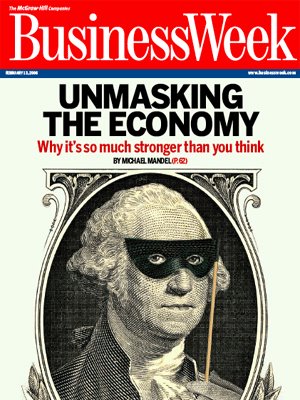
Further proof that the top is in just arrived with this BusinessWeek cover Unmasking The Economy.


Why The Economy Is A Lot Stronger Than You Think


In a knowledge-based world, the traditional measures don't tell the story. Intangibles like R&D are tracked poorly, if at all. Factor them in and everything changes.

In a knowledge-based world, traditional measures don't tell the story! Sheeesh. I wonder what Warren Buffet might think about that. This is just another version of "It's different this time". Haven't we had enough of that already?

There is nothing like magazine covers espousing some new economic nonsense to mark the top. The BusinessWeek cover is perfect.

I congratulated Time Magazine back in June for calling the top in the real estate with this silly cover.


I reported "It's Too Late" immediately after I received this Email ad:


The economy is about to be unmasked alright. It will be exposed for the house of cards that it is, completely dependent on creative financing and worsening credit lending standards, consumer debt, negative savings, and home equity extraction from houses expected to rise in price forever.

Mike Shedlock / Mish
http://globaleconomicanalysis.blogspot.com/

Saturday, February 4, 2006

Chavez Ravine

It goes without saying that architecture and urban issues aren't the most appealing topics for musical compositions. There's the occasional techno release, though music tends to deal with intangibles. Love. Loss. Longing.

But Ry Cooder's latest takes the destruction of the Los Angeles neighborhood of Chavez Ravine to make way for a stadium for the transplanted Dodgers as its concept. If the listener is unsure as to Cooder's take on the now historical incident, the cover makes it pretty clear. A stogie-smoking skeleton wielding a tractor that pummels the small houses under a glowing UFO-like object and blood-red background leaves little room for doubt. This is urban and political criticism set to music.

Missing image - cooder.jpg

The ravine sits just north of downtown LA, the stadium and its sea of parking appearing as large as the central business district. From the beginning of the album, we see Chavez Ravine as a working-class neighborhood, a Mexican-American enclave, traits that make it a potentially easy target for outside development.

Before it became the location of a baseball stadium, it was planned as the site of a major public housing project. Called Elysian Park Heights, the development was designed by Richard Neutra and planned by Frank Wilkinson, who refused to testify in front of the House Un-American Activities Committee for suspicion of being a Communist for his ideas on social housing. Subsequently, he was fired and his project up in smoke, making way for Dodger Stadium. This part of the Chavez Ravine story is found in "Don't Call Me Red", with the priceless lyric:
Richard Neutra is my friend, and he's the man.
He's been to school and he can see what's best for all of you.
Please trust me, my name is Frank, don't turn me down.
Don't call me red.
Missing image - chavez-neutra.jpg

The city evicted about 300 families from the ravine to make way for the housing, demolishing houses, a school, and a church in the process. But after the Frank Wilkinson debacle, the Los Angeles city government sold the property to Walter O'Malley, president of the Brooklyn Dodgers, whose team had just won the World Series in 1955. He built Dodger Stadium on this land razed for public housing, for $12 million. Two years later the ball club moved to LA.

Missing image - chavez-dodgers.jpg

But before the scene above...
In 1949, photographer Don Normark visited Chavez Ravine...Enchanted, he stayed for a year and took hundreds of photographs documenting community life. But little did Normark know that he was capturing the last images of a place that was about to disappear.
Missing image - chavez-normark.jpg

These images are captured in a book, Chavez Ravine: 1949, and a PBS documentary, Chavez Ravine: A Los Angeles Story. One year after Normark's images were taken, residents were given eviction notices, the neighborhood viewed by outsiders as a "vacant shantytown" and an "eyesore." Need thriving communities be beautiful?

It's these photographs that inspired Ry Cooder to make this album. Even though he never visited the Ravine before its razing, he "misses the texture of certain older neighborhoods...a rural feel in urban places...peace and quiet." He spins fiction and non-fiction across its 15 songs, culminating in an album that captures the period and the resident's struggles. Cooder is clearly critical of universality and technology, ideas that were taking shape in the 1950s. For him, the reality of a place formed by its residents is more important than "a town's that flat...a street's that's tame."

Missing image - chavez-panorama.jpg

According to AMG, "Cooder sought out musicians from the era and the place, including the late Pachuco boogie boss Don Tosti, the late legendary Lalo Guerrero (the guiding force and spirit of the album who also passed away after contributing), Ersi Arvizu, and Little Willie G." I'm in agreement with their review that says the album is sad and beautiful, funny, quirky and funky. It's listenable and pleasurable beyond its conceptual leanings, though bilingual liner notes make the intentions behind each song ring loud and clear.
 
Copyright 2010 Camera Dashboard. All rights reserved.
Themes by Ex Templates Blogger Templates l Home Recordings l Studio Rekaman