Wednesday, April 28, 2010

Kodak EasyShare C180 Digital Camera (Silver)

Kodak EasyShare C180 Digital Camera (Silver) Review


It is a little camera. I bought it after owning another Kodak Easy Share camera for several years. And 'much smaller than the old camera, beauty and the screen is much bigger on the back, which is great! I love the fact that it is very easy to change camera settings for the type of image you are adjusting. All you have to do is turn the knob and "poof" you are for action shots or video, or whatever you set! There are only two problemsI will use this camera ... The battery does not last! I also bought the most expensive "Ultra advanced batteries and does not seem to make a difference. The other problem is that if you have a video record and play to the camera, there is no sound. The sound is there when you load on a computer but not on the same camera on the whole I would give this camera a "thumbs up".


Kodak EasyShare C180 Digital Camera (Silver) Feature


  • 10.2-megapixel resolution for stunning prints up to 30 x 40 inches
  • Kodak AF 3x optical aspheric zoom lens (35 mm equivalent: 32 - 96 mm)
  • Capture beautiful HD pictures in 16:9 format; view in high definition on an HDTV or other HD device
  • 2.4-inch LCD screen; Face Detection, Blur Reduction features
  • Capture images to SD/SDHC memory cards (not included)


Kodak EasyShare C180 Digital Camera (Silver) Overview


Kodak EasyShare C180 Digital Camera Silver


Available at Amazon Check Price Now!


*** Product Information and Prices Stored: Apr 28, 2010 08:22:18

China's Nonexistent Rebalancing Act

In March, China's trade surplus turned into a deficit, prompting some pundits to proclaim that China's economy was rebalancing. Others pointed to a surge in auto buying as proof consumer demand in China was picking up steam.

I did not buy either of those arguments, and instead proposed the numbers were indicative of collapse in US demand for Chinese goods coupled with massive surge in Chinese buying of commodities at ever increasing prices.

Samuel Sherraden, writing for the New America Foundation, makes that case nicely in Why Trade Figures Do Not Prove China Is Rebalancing
China�s trade surplus declined in the first quarter, and during March the country ran a deficit of $7.2 billion, its first monthly trade deficit since 2004. Contrary to some analyses, this is not proof that the economy has made significant progress toward rebalancing or a reason for the United States to back away from pushing China on yuan appreciation.

The short-run decline in the trade balance was driven by seasonal effects, a slowdown in China�s export markets, and a surge in raw materials imports - none of which indicate that China is making a transition to an economy driven by greater consumer demand.

On the contrary, a breakdown of trade figures indicates that although demand has returned, it is largely related to investment-led growth, not to consumer demand.


Weak export growth was a consequence of weak recoveries in the European Union, United States, and Japan, which accounted for 46% of China�s exports in 2008. Even though exports to the EU, US, and Japan increased by 25%, 17%, and 19% YOY in March 2010, these gains barely made up for the decline during the previous year. In other words, exports to China�s major trading partners have remained flat since 2008 (see Chart 2).


Import Demand Increased

While export growth remained subdued, import growth has surged. But the increase in imports reflects an intensification of investment-driven growth and demand for commodities and materials, not a move to greater consumer demand.[1] Fixed asset investment grew 25.6% in the first quarter of 2010 compared to the first quarter of 2009. Partly as a result, China imported $27.6 billion more commodities and materials in March 2010 than in March 2009, an increase of 77.1% YOY. This was the major driver of the $25.8 billion decline in the trade balance during the same period.

Evidence of Consumer Goods Imports?

Motor vehicles imports have soared on the back of strong government subsidies and increased demand, but imports of other consumer goods have not grown as quickly and in some cases have declined. During the last six months (October 2009 - March 2010), motor vehicle imports increased 211% from the same period last year. During the same period, imports of furniture and footwear increased by 15.4% and 5.3%, respectively, but clothing imports declined by 6.9% (see Chart 5). During the six months between September 2009 and February 2010, imports of air conditioners increased 9.0% but imports of televisions declined 54.6% from the same time period last year. In short, with the exception of motor vehicles, imports of consumer goods remained relatively weak, with some areas showing modest gains and others showing losses.


At first glance, increased imports of motor vehicles would tend to support the argument that China is rebalancing. But on closer examination, one would see that the demand for cars has been driven by a government strategy to develop a strong domestic auto sector, not by a goal of creating a more consumer-oriented economy. Policies to support the auto sector, which included significant subsidies for purchasers and producers of fuel efficient vehicles, were partly responsible for dramatic increases in sales during 2009 and the first quarter of 2010. While some stimulus to the auto sector will expire in 2010, subsidies will continue for gas vehicles with engines smaller than 1.6 liters; �cash for clunkers� rebates in rural areas of up to 18,000 yuan ($2,632); and rebates for �new energy� cars, or fully electric cars, of up to 60,000 yuan ($8,775).

Conclusion

China�s trade balance has declined because China�s stimulus program intensified investment-led growth, increasing demand for commodities and capital goods. Based on our analysis, it is not evident that China has made progress toward rebalancing to a more consumer-oriented economy. ...

Excessive bank lending since the beginning of 2009 incentivized stockpiling of commodities and materials and the development of spare capacity. A tightening cycle could force enterprises in China to reduce imports and rely on existing commodity stockpiles and excess capacity to increase exports, leading to a rise in the trade surplus.

There is a danger, then, that the recent trade figures will temporarily reduce pressure on China to rebalance its economy. Given the likelihood that China�s investment-heavy stimulus will lead to a new surge in China�s net exports, it is even more important that the United States develop a strategy to encourage China to undertake structural reforms to rebalance its economy. Revaluation of the yuan, although no substitute for longer term structural changes, would be a good place to start.
There are more charts in the article related to Chinese demand for commodities. I encourage everyone to take a closer look.

Artificial Demand

The important point, but one that the article did not explicitly make is that China's demand for commodities is hugely artificial, predicated on round after round of stimulus and outright monetary printing that has also fueled massive property bubbles and speculation.

So before one can even talk about ways to rebalance, global stimulus needs to stop. Yet, China Business says Another $586 billion "Stimulus" Coming to China.

Regardless, hoping to balance the US trade deficit with China by pegging the Renminbi (RMB) to some arbitrary level is a fool's mission as noted in Why Repegging the Yuan and Other Non-Free-Market Solutions to Trade Imbalances With China Will Fail

The notion the RMB is hugely undervalued is in part predicated on a belief the Chinese economy is a lot better than it is. Indeed, near unanimous opinion suggests the RMB would soar if China floated it.

Here's a question to ponder: What would happen if China stopped its stimulus cold turkey, pricked its property bubbles, and allowed the RMB to float freely, and in response the Chinese stock market collapsed, social unrest picked up, and hot money poured out of China?

Would the RMB soar in those conditions? I rather doubt it. Yet those conditions are what I would expect if China stopped its speculative bubbles.

The way to find out the true state of affairs is for China to float the RMB, central bankers to allow the market to set rates, and for governments worldwide to stop fiscal madness. That is also the way to rebalance the global economy.

Unfortunately, central bankers and governments won't take that set of actions, preferring instead to blame China's RMB peg for the world's ills.

Mike "Mish" Shedlock
http://globaleconomicanalysis.blogspot.com
Click Here To Scroll Thru My Recent Post List

Tuesday, April 27, 2010

Decrapification: The kitchen

Hellooooo there! First things first � the randomly drawn winner of the $50 HomeGoods gift card is Wanda from Bunco Babes! Wanda, email me your address and I�ll get that sent out to you!

I know I�ve been going on and on about the big boy room and I am REALLY hoping to show you this week. (Finishing touches are SO close to done!!) But even when I�m working on a cutie patootie room for my cute patoot, I still can�t help but declutter and organize around the joint.  ;)

It still amazes me to no end that I can go through a space once, and still find more CRAP just a couple months later. I don�t know if I missed it the first time, was just lazy, or as time goes on and more comes into the house, I feel the need decrapify even more stuff.

I just went through the kitchen a couple months ago, but this week I found more crapwehaven�tused for YEARS:

crapTravel coffee mug for coffee we don�t drink?

Check.

Disney cup that has leaked every. single. time. we�ve used it?

Check.

Kitty treats that are healthy so the cats won�t touch them?

Check.

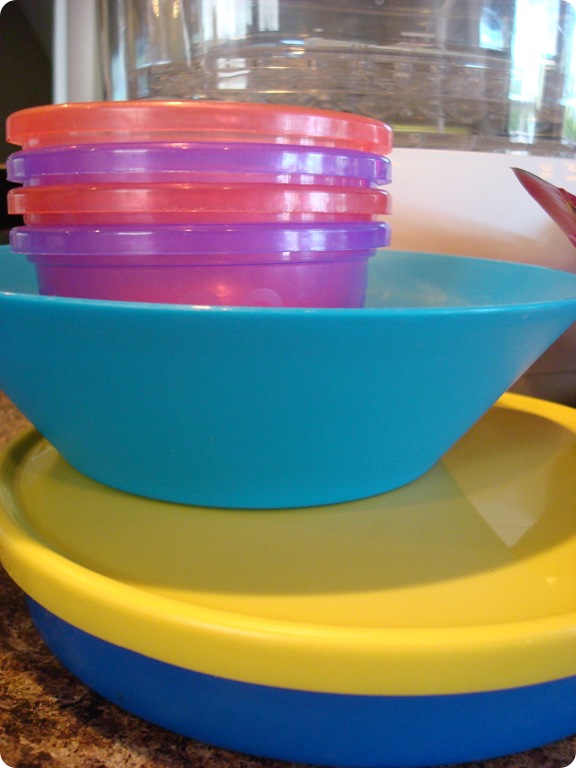
The other stuff is random things that I haven�t needed for a very long time � odd bowls, containers without lids, a steamer we haven�t used for seven years. (Really.)

I use the same �rules� for items around the house that I use for clothes. What�s the rule � if you haven�t worn it in six months it�s out? Well, the rules are the same for stuff � just longer. I go by a year or two for kitchen stuff. (Or seven. Whatever.)

It depends on how expensive it was to begin with � but seriously, if we NEVER use it, WHY am I keeping it? Ugh!

One of our cabinets in the kitchen hold a weird mix of stuff � medicine, candy and birthday/party stuff:

The yellow baskets hold medicine/vitamins and were dollar store finds. The candy jars have lids I�m painting (for two months now) and were from Goodwill. The little gumball machine with the Halloween candy in it (?!) was a Goodwill find too.

I went through the medicine this week and ALL of this had expired:

expired crap

Most of them were close to empty, except the teething tablets, that we haven�t used in two years. (Again -- ?!)

There�s a few tricks I use to keep things organized in the kitchen. I keep baking items in one drawer, randoms in another:

I got so tired of trying to find measuring spoon in the sea of utensils, I ended up separating them and it�s SO much easier.

Our cabinets had a couple drawer organizers that came with them, but I find I can fit a TON more in the drawer without the organizer:

It�s not pretty, but it works!

I�d love to buy those fab cabinet/pull out/organizer thingies someday, but until then, I use a dollar store display to keep pans and cutting boards where I want them:

These are used to display their plates, and on a trip in one day, I saw an empty one � I asked the manager if I could buy it and he told me I could take it home. For fareee! It never hurts to ask!

I secured it to the bottom of the cabinet so it won�t move around:

A free solution. You can�t beat that baby!

I use a pot rack for large pots and pan storage. They aren�t for everyone, but I do love ours:

I got this one half off at Hob Lob years ago, and it saves a TON of cabinet space. (Just make sure you hang it high enough so it doesn�t block your view!)

I use the space above the microwave for Bub stuff that makes messes � bubbles, water toys, play dough:

039

All things we do in the kitchen or outside so it�s a convenient spot for them. And he can�t get the bubbles out himself.  :) (Translation � get bubbles out himself and spill them everywhere.) 

There are items I�ve moved down just so he can reach them though � I�ve put all of his plates/bowls/napkins in the lazy susan so he can get them himself:

He love, love, LOVES to help now, so this is a good way for him to do that.

There are a few things we had installed when we built our house that I now know I could never eva live without. The appliance �garage� is one:

My heart goes pitter pat for this thing. I hide our blender, toaster and can opener inside. Which means we have ZERO appliances on the counter. BLISS!

I had tip out trays installed in the kitchen and the master bathroom:

024OH how they ROCK. Now you can buy these in the store and it�s easy peasy to install them. I don�t know the price (share if you�ve bought them!) � but they are my secret storage space for sponges and cleaning supplies and toothbrushes and toothpaste (in the bathroom of course!)

I�ve told you all before that when we picked out our upgrades on this house all those years ago, I was hyperventilating and itching because hubby kept adding things like �surround sound� and �security system� and all I heard was �money� and �more money.�

Now, of course I�m glad he did add those things, and one of my very favorites he insisted on was our trash compactor:

It is the shizzle!! ;) I mean, really, it is. We have one bag of trash a week. Even when we have a party. Cross my heart, pinky swear. SO worth the money!!

And the best part is we don�t have to worry about a spot for a trash can or smell stinky trash. Ewweee!

I love our decrapified, organized kitchen:

It is getting a mini redo this summer though. Maybe not mini. A little more than a mini. I�m going to brighten the place up and I cannot wait!! (Nooo� I am not painting cabinets.) I don�t think.

No. I�m not.

Probably.

Seriously � I think that may put hubby over the edge. It takes a lot and that would do it.  ;)

Any great decluttering tips you follow for your kitchen? Found an organizing gadget that helps? Share with us please!

If you want to see my decluttered pantry:

organized pantry

Click here.

Building Poetry

Wrapping up the Lower Manhattan chapter for my NYC guidebook I came across the below video at the Poets House web page. Their new home is by Louise Braverman Architect and is inside Riverhouse by Polshek Partnership Architects. Those who know me are already aware I have a hard time passing up anything with Bill Murray.

Foxes Ask For Sturdier Henhouses

It's not every day that foxes openly campaign for more safeguards on the henhouse. Yet today it happened twice.

Let's take a look starting with Citi�s Pandit Writes Obama in Support of Regulatory Overhaul
Citigroup Inc. Chief Executive Officer Vikram Pandit wrote President Barack Obama endorsing �strong regulatory reform� for U.S. banks, saying it would restore trust and confidence in the financial system.

�I have been a firm advocate of strong regulatory reform,� Pandit said in the letter to Obama obtained by Bloomberg News. �You can count on me and the entire Citi organization to support� overhaul efforts.

The letter was dated April 23, a day after Obama�s speech in New York in which the president challenged the financial industry to join the effort to revamp market regulations and said what happens on Wall Street has consequences throughout the nation.

�I believe banks should not speculate with their capital,� that �derivatives should be cleared and settled centrally� and that there needs to be �a strong federal consumer authority to protect consumer interests,� Pandit wrote.
OK Fair enough, prove it.

Mr. Pandit, let's see some specific proposals. Are you in favor of Glass Steagall? Completely ending proprietary trading? Breaking up Citigroup? What specific recommendations do you have on derivatives?

Until you come out and say exactly what you support or don't, color me skeptical.

Bernanke Says Budget Gap Might Raise Interest Rates

In yet another fox and chicken play, Bernanke Says Budget Gap Might Raise Interest Rates.
Federal Reserve Chairman Ben S. Bernanke said a failure to reduce the federal budget deficit may push up interest rates over time and impair economic growth, putting the recovery at risk.

�Achieving long-term fiscal sustainability will be difficult, but the costs of failing to do so could be very high,� Bernanke said in a speech today to a White House commission on the budget deficit. �Increasing levels of government debt relative to the size of the economy can lead to higher interest rates, which inhibit capital formation and productivity growth -- and might even put the current economic recovery at risk.�

Budget deficits may eventually erode the confidence of bond investors in the management of U.S. fiscal policy, driving yields higher on Treasury borrowing, raising the cost of lending in the economy and slowing economic growth, Bernanke said.

The Obama administration estimates budget deficits will total $5.1 trillion over five years and hit a record $1.6 trillion in the year ending Sept. 30. The $1.4 trillion deficit in 2009 was equal to 9.9 percent of gross domestic product, the largest share since the end of the World War II.
OK Ben. Let's see some actions not yapping. Hike rates, stop monetizing government debt regardless of what happens, unwind your bloated asset sheet, and sign off on an independent audit of the Fed.

Bernanke and Pandit sound like foxes arguing for locks on the front door of henhouse while simultaneously proposing no locks on the back door, the keys to the front door, and secret tunnels into the building just to be safe.

Mike "Mish" Shedlock
http://globaleconomicanalysis.blogspot.com
Click Here To Scroll Thru My Recent Post List

Does the Global Imbalance Matter Yet? Did Ken Fisher Just Ring the Bell?

With the Obama administration and most of mainstream media singing the praises of a recovery that is really nothing more than governments around the globe throwing unsustainable amounts of "stimulus" money at various problems, I am wondering when the global imbalances finally start to matter.

Was today the day?

Here are some charts to consider.

Gold Up, Silver and Nonprecious Metals Down


Energy Sector Down


Financials Up


US Dollar, Yen Rally


European Equities Hammered


Asian Equities Down, China Leads the Way


US Equities Down


Analysis

Today's action is certainly a flight to safety phenomenon with gold, US treasuries, and the US dollar all rallying strongly with nearly everything else selling off.

Silver is primarily an industrial metal, while gold is best viewed as money or a currency. Moreover the entire energy complex took a hit.

Another One Day Wonder?

Inquiring minds are no doubt asking if this is another one day wonder, buy the dip decline, or the start of something far more serious.

I do not know nor does anyone else. What I do know is risk is high, risk-reward is skewed to the downside, and if this recovery was real it would show in housing, jobs, and termination of global stimulus plans.

Instead housing is in the dumps, the official unemployment rate is near 10%, and in spite of massive property bubbles in China, the China Business Newspaper says Another $586 billion "Stimulus" Coming to China.

Meanwhile, Ken Fisher is a huge fan of emerging markets and tells the bears to "Get In Before It's Too Late".

Get in before it's too late?!

Flashback: December 13, 2005: It's Too Late
I think it's too late.
In fact I know it's too late.
How do I know?
The following Email I received tonight should explain it nicely.
When you see stuff like this, not only is it too late, it's way too late.


Did Ken Fisher just ring the bell?
Time will tell.

Mike "Mish" Shedlock
http://globaleconomicanalysis.blogspot.com
Click Here To Scroll Thru My Recent Post List

Book Review: Great Public Squares

Great Public Squares: An Architect's Selection by Robert F. Gatje
W. W. Norton, 2010
Hardcover, 224 pages

book-gatje.jpg

At a time when architecture books tend to focus on buildings, the objects that inhabit cities, it's refreshing to see a book squarely focused on public space, pardon the pun. Robert F. Gatje, a former partner of both Marcel Breuer and Richard Meier, has assembled plans, photos, stats and descriptions on forty squares, most in Europe. Inspired by Camillo Sitte and other authors of books on urban spaces, the CAD-generated plans are rendered consistently (per the cover) and at the same scale, accompanied by dimensions, areas and other data in an effort to make the book a comparative study. Lest the book get bogged down in top-down views of city plans, the photos and descriptions go a long way towards giving readers a sense of what each space is like, while also providing historical information on the mostly old spaces (the most recent is Pioneer Courthouse Square in Portland, Oregon, here marked by the construction start of 1981).

The lack of contemporary spaces makes me wonder if and why squares cannot be designed to the same effect as the ones presented here. Is it due to the quality and style of the buildings that overlook the squares? Is it the design of the spaces themselves? Or maybe the lack of decent spaces in cities for creating new squares? One need only look at the Project for Public Space's Hall of Shame to see that new spaces are perceived as lacking in a number of ways (empty, unsafe, uninviting, etc.). Most of the members of the less-than-illustrious list are modernist and later creations, many surrounded by newer developments or within the post-industrial landscape of cities. While PPS's list is certainly debatable, the apparent link between urban squares and the urban fabric around them is hard to deny. This is most strongly felt in Italy, from which 15 of the 40 squares in the book come. This link points to the importance of the larger context in the success of these urban spaces, not the comparative data that Gatje presents.

So Gatje has delivered a carefully and lovingly crafted book that can be seen as an homage to western history's greatest public squares, or as a lesson on how public squares can be created in a less "shameful" way. Living in New York City, I can't help but think that a number of potentially great squares exist, such as Gansevoort Plaza in the Meatpacking District and the pedestrian zones in Times Square. But as is, devoid of the care required to make them great as well as popular, the spaces merely set aside, not designed. Investments towards implementing more permanent and careful designs need to happen. When they do, Gatje's book is a very good place to learn from the successes of the past.

US: Buy from  Amazon.com CA: Buy from  Amazon.ca UK: Buy from  Amazon.co.uk

NOTE: Gatje will present an illustrated talk on his new book at the Center for Architecture tomorrow, April 28 at 6pm. The event is free and open to all. RSVP here.
 
Copyright 2010 Camera Dashboard. All rights reserved.
Themes by Ex Templates Blogger Templates l Home Recordings l Studio Rekaman