Monday, September 25, 2006

Monday, Monday

My weekly page update:
missing image - image01sm.jpg
BMW Plant Leipzig in Leipzig, Germany by Zaha Hadid Architects.

The updated book feature is Zaha Hadid: BMW Central Building, edited by Todd Gannon.

Some non-Zaha Hadid links for your enjoyment:
Arkinetia
Well-done architecture blog, in Spanish. (added to sidebar under blogs::architecture; thanks Damian!)

Francis Morrone Q&A
An interview with one of the Blowhards. (thanks Andrew K!)

Sunday, September 24, 2006

House of Light

Before the recent move I "clipped" this article at PingMag to read later...well, I'm finally getting around to it today. "Staying in James Turrell's House of Light" describes "a modern-built, traditional-style Japanese house where people can stay to experience light in a variety of specific conditions that [Turrell] has arranged for, all centered around a sky-viewing room."

For those unfamiliar with James Turrell, his signature installations are skyspaces that feature a ceiling aperture open to the sky, making it appear flattened, almost pure color. These spaces are intended to influence the viewer's way of thinking via perception. As can be seen by this set, I'm smitten with them.

Missing image - houseoflight.jpg

And after seeing the PingMag article, it looks like I have another reason to return to Japan, to not just sit in a Turrell but to stay in one.

Saturday, September 23, 2006

Today's archidose #32

Inside a rainbow
Inside a rainbow by rutger_spoelstra
Offices La Defence in Almere, Netherlands by UN Studio (Ben van Berkel, Caroline Bos).

To contribute your Flickr images for consideration, just:
:: Join and add photos to the archidose pool, and/or
:: Tag your photos archidose

Friday, September 22, 2006

Discussion on Zeros

Bloomberg is reporting EU Renews WTO Complaint Over U.S. `Zeroing' Practice.
The European Union wants World Trade Organization judges to prohibit U.S. customs-duty calculations that the 25-nation bloc says illegally inflate import tariffs.

The calculation, called "zeroing," enables the U.S. to maximize import duties by selectively excluding some market price data. The U.S. used the methodology to work out whether imports of chemicals, steel and pasta from the EU were sold below cost, or dumped, on the domestic market. The WTO ruled in favor of Japan in a similar complaint in February 2005.

Today's filing renews previous complaints because while WTO arbitrators in the past have faulted the U.S.'s use of the zeroing methodology in specific instances, they haven't outlawed the practice in principle. The complaint may further sour relations between the U.S. and EU that were strained by finger- pointing after the collapse of the Doha trade talks round.

"Zeroing ignores negative margins of dumping and therefore results in an unfair increase of the dumping liability of EU exporters," the EU said in a statement today. While the WTO has ruled against the use of zeroing by the U.S. at least three times, ``these previous rulings left open a number of issues which are now covered by the new request for consultations.''

Eliminating the zeroing practice would mean makers of hot- rolled steel, stainless steel bar, ball bearings, chemical and pasta products would pay minimal import duties, or none at all, according to the EU. Most U.S. tariffs on European companies including ThyssenKrupp AG, Corus Group Plc and BASF AG are based in part on zeroing calculations, the bloc says.
Protectionist trade policies are one of the hallmarks of deflationary times so it is should be no surprise that two zeros (Senators Charles Schumer, a New York Democrat, and Lindsey Graham, a South Carolina Republican) are once again threatening to impose 27.5% tariffs on China.

The Boston Globe is reporting Senate likely to pass China tariff bill.
The Senate is likely to pass a bill aimed at forcing China to change its currency policies by threatening a 27.5 percent tariff on its exports to the United States, a top Republican senator said on Thursday.

"I would expect it to pass and I'm sorry for that," said Senate Finance Committee Chairman Charles Grassley of Iowa.

Senate leaders have promised Sens. Charles Schumer, a New York Democrat, and Lindsey Graham, a South Carolina Republican, a vote next week on their bill threatening China with punitive tariffs.

Grassley, whose committee has jurisdiction over trade legislation, said he expected the vote to occur even though it could herald a return to the Smoot-Hawley tariff policies of the 1930s that are blamed by many economists for starting or at least protracting the Great Depression.

There is currently no similar bill in the House and the Bush administration strongly opposes the legislation.

However, many business groups and trade experts warn that even a Senate vote in favor of the bill could hurt trade relations with China.

"Senate passage ... alone will have negative repercussions for U.S. farmers, manufacturers, service providers and others, while undercutting, rather than promoting, the objectives it seeks to achieve," the Emergency Committee for American Trade, which is comprised of leading U.S. exporters and importers, said in a letter to all 100 members of the Senate.

U.S. manufacturers say China's currency is undervalued by 15 percent to 40 percent against the U.S. dollar, giving Chinese competitors an unfair advantage.

The Graham-Schumer bill directs the White House to impose a 27.5 percent tariff on goods from China if Beijing does not significantly raise the value of its currency within six months. That punishment could be delayed for 12 more months if China has begun implementing a plan to revalue its currency.
I called the last two attempts to bring such legislation to the floor for a vote "big bluffs" and in both cases although China did nothing the US Senate backed down. Is the third time the charm? Does the Senate finally have the nerve (and the stupidity) to pass something as ill conceived as this? It almost seems like it. Given that there is no pending House bill it is not likely to go anywhere but if someone wanted to engineer a stock market crash this surely would be the way to do it.

By the way Smoot-Hawley did not cause the Great Depression. It did however make it worse. The cause of the Great Depression was a reckless and prolonged expansion of money and credit leading up to the 1929 crash. Yes, it really is as simple as that although the explanation as to how and why and in what timeframe that occurred is a much longer story for perhaps another time.

Bernanke for all of his supposed depression expertise does not understand that simple statement. If he did, he never would have issued his infamous "Helicopter Drop" speech, Deflation: Making Sure "It" Doesn't Happen Here.
As I have mentioned, some observers have concluded that when the central bank's policy rate falls to zero--its practical minimum--monetary policy loses its ability to further stimulate aggregate demand and the economy. At a broad conceptual level, and in my view in practice as well, this conclusion is clearly mistaken. Indeed, under a fiat (that is, paper) money system, a government (in practice, the central bank in cooperation with other agencies) should always be able to generate increased nominal spending and inflation, even when the short-term nominal interest rate is at zero.

The U.S. government has a technology, called a printing press (or, today, its electronic equivalent), that allows it to produce as many U.S. dollars as it wishes at essentially no cost. By increasing the number of U.S. dollars in circulation, or even by credibly threatening to do so, the U.S. government can also reduce the value of a dollar in terms of goods and services, which is equivalent to raising the prices in dollars of those goods and services. We conclude that, under a paper-money system, a determined government can always generate higher spending and hence positive inflation.

Even if households decided not to increase consumption but instead re-balanced their portfolios by using their extra cash to acquire real and financial assets, the resulting increase in asset values would lower the cost of capital and improve the balance sheet positions of potential borrowers. A money-financed tax cut is essentially equivalent to Milton Friedman's famous "helicopter drop" of money.
The important point to understand is that if reckless monetary expansion was the cause of the Great Depression (and it was) then it is impossible for reckless monetary expansion to be the cure. At best, such persistent recklessness would prolong the problem making the inevitable bust all the more severe. Furthermore there is theory and there is practice. One of the consequences to purposely causing hyperinflation is that it would destroy the US$, it would destroy the banking system, and it would destroy the Fed and all their wealth and power. For practical reasons there simply will be no "helicopter drop".

As I pointed out in Inflation: What the heck is it? Ludwig von Mises understands the endgame brought on by reckless expansion of credit: "There is no means of avoiding the final collapse of a boom brought about by credit (debt) expansion. The alternative is only whether the crisis should come sooner as the result of a voluntary abandonment of further credit (debt) expansion, or later as a final and total catastrophe of the currency system involved."

This leads us to our final zero for the day. If one was grading the understanding of credit expansions and depressions, the result would be Ludwig von Mises:100 Bernanke:0.

Mike Shedlock / Mish
http://globaleconomicanalysis.blogspot.com/

Thursday, September 21, 2006

Kiss Goldilocks Goodbye

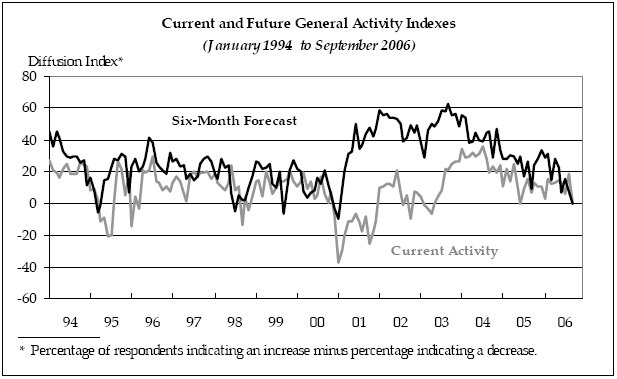
The Philly Fed Survey for September shows that Growth Stalls this Month
The survey�s broadest measure of manufacturing conditions, the diffusion index of current activity, dropped from 18.5 in August to -0.4 this month. This is the first negative reading in the index since April 2003, although the index registered a zero reading in June 2005 (Chart ). Twenty-seven percent of the firms reported increased activity this month, down from 35 percent in August. The percentage of firms reporting deteriorating conditions rose from 17 percent in August to 28 percent this month. The new orders and shipments indexes both fell precipitously this month: the new orders index fell 17 points, and the shipments index fell 29 points, both recording their first negative readings since April 2003. Both the delivery times and unfilled orders indexes edged lower and into negative territory, following slightly positive readings in August.

Cost Increases Less Widespread

Respondents reported increased costs for inputs again this month, but increases were not as widespread as in previous surveys. The prices paid index remained at a relatively high reading of 38 but receded seven points from August. Forty-one percent of the firms reported higher input prices; only 3 percent reported lower prices.

Twenty-seven percent of the firms reported higher prices for final manufactured goods, up slightly from the 25 percent that reported increases last month. The prices received index increased nearly five points this month.


Special Questions (September 2006)

Do you expect the following capital expenditure categories in 2007 to be higher than, lower than, or the same as in the current year?


Take a good hard look at the number circled in red above.
No ask yourself how likely it will be that business spending and growth is going to take up the slack for slumping housing and consumer spending.

We can now put to bed the myth that a "Goldilocks Scenario" of a soft landing in housing coupled with a business expansion will keep the economy humming.

Dispelling Goldilocks
  • We have never had a soft landing in housing before so why should we have one now?
  • We have never had a national housing bubble to this extent before and we surely have one now.
  • Typically consumer spending is somewhere between 67% and 75% of the economy. In this recovery consumer spending and housing may be as high as 80-85% of the economy. It is well beyond silly to expect business spending can counteract a decline in consumer spending, housing and housing related activity.
  • The above numbers show serious contraction in structures. This will amplify the turn down in housing.
  • Retail store expansion is surely not going to pick up any slack either. It seems robust now only because it is following housing with a lag (new subdivisions are built and new strip malls and retail stores follow). We still have expansion for now, but that is for stores planned long ago.
  • The overbuilding of housing and condos continues. This is going to continue to put pressure on prices.
  • Falling housing prices will stall cash out refis and housing ATM spending.
As I stated above things "seem" OK for now. Given the lag between housing expansion and retail store, strip mall, and restaurant expansion I expect that at some point (probably very soon now) we are going to see "lights out" on such retail expansion just as we saw a dead halt to condo and home sales in numerous places.

As shown in the above charts, manufacturing sure is not coming to the rescue either. So where is job growth supposed to come from? I suggest nowhere. It's time to kiss Goldilocks goodbye.

Mike Shedlock / Mish
http://globaleconomicanalysis.blogspot.com/

Three Bits

One::
Corflot notifies me that their 2006 Design Salary Survey is up and running. Unlike previous years, this survey features an architecture concentration in addition to the other design-oriented areas of concentration. Take it now.
Two::
Good Magazine features the article "Chasing Zero" by Ben Jervey, author of The Big Green Apple. In it the author documents his "month-long experiment in extreme urban environmentalism."
Three::
My DSL modem arrived in the mail last night! After some initial problems connecting, it's now up and running. What does this mean? Mainly that when I get home tonite I'll send out my backlog of subscription notices to my weekly readers. And after that those notices will return to their regular frequency, once a week.

Wednesday, September 20, 2006

September FOMC Analysis

People always beat me to these comparisons but I thought it might be helpful to pass on the best of the FOMC statement to statement comparisons.

In The Fed Leaves Target Rate Unchanged at 5.25% Mark Thoma writing for the Economist's View points out every single word change from last month to this month.
  1. They have dropped the word "gradual" from their description of the cooling of the housing market.
  2. They see energy prices as moderating. The statement no longer mentions energy prices as a potential cause of slower growth, but energy prices are mentioned as a reason to expect inflation to moderate.
  3. Just like last meeting, the vote wasn't unanimous - Jeffrey Lacker dissented.
  4. The Committee notes, as it did last meeting, that inflation risks remain and further rate moves will depend upon how these risks play out. It does not mention risks to economic growth explicitly as it does with inflation, but housing is mentioned as a growth moderating factor.
Note: There is a chart of the exact before and after statements in the above link and the above four points sound more significant than they look in the chart (and from my ears they do not sound very significant at all). Besides point #3 above is not even a difference.

Tim Duy called the statements Unsatisfying.
Like almost everyone, I was expecting policy to remain essentially unchanged at the conclusion of today�s FOMC meeting. Still, I was left unsatisfied by the accompanying statement, posted by Mark Thoma. At best, its brevity makes it look straightforward. At worst, it looks like something cobbled together because FOMC members were unable to reach a uniform opinion on the state of the economy.

They only mention the housing slowdown in explaining why the economy �appears� to be moderating. If that was the only factor they are looking at, wouldn�t you expect a more definitive forecast? As Jim Hamilton reminds us, you can�t exactly miss the relationship between housing and recessions. If housing is your focus, cut rates now! They didn�t cut rates, so there must be more. So where is the rest of their analysis? What are the factors that offset the housing slowdown? Inquiring minds want to know.

OK, so they don�t completely know which way the economy is headed; not entirely unexpected, given that the US economy is almost certainly at an inflection point (although I like to see a bit more confidence from my central bankers, or at least another explanatory sentence). But I would expect the Fed to have a better handle on the inflation situation. Unfortunately, the third paragraph doesn�t leave me very confident on that front either. In the first sentence, energy prices have the �potential to sustain inflation pressures.� In the second sentence, inflation pressures are likely to moderate due to the �reduced impetus from energy prices.� What? WHAT!?! Are energy prices contributing to inflation or not? Shouldn�t the FOMC have an opinion on the impact of energy prices on inflation?
The person best summing up the silliness of it all was Kevin Depew at Minyanville who offered this analysis:
  • Fed's Lacker dissents, asked for hike (didn't get it)
  • Energy prices have the potential to sustain inflation (doesn't mention CRB Index breaking down or Crude down 19%, Natural Gas down 30% and unleaded gas down 32% since the last FOMC meeting)
  • Inflation Pressures also likely to moderate (due to reduced impetus from energy)
  • Further tightening may be needed (though apparently not soon enough for Lacker)
  • Repeats housing is "cooling" (removes the word "gradual")
So, to sum up, the housing market is now "cooling," though no longer "gradually cooling," and energy prices can potentially sustain inflation while the reduced impetus from energy prices will cause inflationary pressures to moderate. Got it?

Mike Shedlock / Mish
http://globaleconomicanalysis.blogspot.com/

 
Copyright 2010 Camera Dashboard. All rights reserved.
Themes by Ex Templates Blogger Templates l Home Recordings l Studio Rekaman