Tuesday, January 4, 2011

Ricoh GXR Interchangeable Unit Digital Camera System with 3-Inch High-Resolution LCD

Ricoh GXR Interchangeable Unit Digital Camera System with 3-Inch High-Resolution LCD Review


Ricoh GXR Interchangeable Unit Digital Camera System with 3-Inch High-Resolution LCD Feature

  • Interchangeable unit camera system; lenses and sensors are added by using a slide-in mount system to attach camera units to the body
  • Base system only; lenses and sensors sold separately
  • Die-cast magnesium body and corrosion-resistant coating for superior durability and light weight
  • High-resolution 3-inch LCD provides a wide viewing angle and high contrast
  • 86 MB built-in memory; capture images to SD/SDHC memory cards (not included)

Ricoh GXR Interchangeable Unit Digital Camera System with 3-Inch High-Resolution LCD Overview

GXR Interchangeable Unit Camera System features the world's smallest and lightest digital camera with interchanegable lens capability. The new GXR is an interchangeable unit camera system in which lenses are changed by using a slide-in mount system to attach camera units to the body. The lens, image sensor, and image processing engine are integrated into the camera units so the body itself does not contain an image sensor. The adoption of this new system has made it possible to achieve both "pocket size for go-anywhere portability" and "the highest image quality for every photographic situation and subject." In addition, since the image sensor is not exposed when lenses are changed, the camera's structure makes it inherently difficult for dirt and dust to get inside. Elegant design For the exterior, we utilized die cast magnesium, which has a strong track record in the GR series, and we covered the surface with a corrosion-resistant "pear-skin" coating. The end result is a body with superior levels of durability, light weight, and feel in hand. Building on the operation control designs of the GR series and GX series, the GXR has several types of customizable buttons as wellas the new DIRECT button, which the photographer can use to see many current settings at a glance. Sophisticated shooting settings can now be made faster than ever before. The directional pad, the three My Settings, the ADJ.lever, and the f

Available at Amazon Check Price Now!


*** Product Information and Prices Stored: Jan 04, 2011 12:30:40

Cash-Strapped States Seek Laws To Curb Labor Union Power

In a growing, justified wave of public-union resentment, at least 10 states seek to make major changes in labor law. Radical proposals come from newly elected governors in Wisconsin and Ohio.

I heartily endorse Strained States Turning to Laws to Curb Labor Unions
Faced with growing budget deficits and restive taxpayers, elected officials from Maine to Alabama, Ohio to Arizona, are pushing new legislation to limit the power of labor unions, particularly those representing government workers, in collective bargaining and politics.

On Wednesday, for example, New York�s new Democratic governor, Andrew M. Cuomo, is expected to call for a one-year salary freeze for state workers, a move that would save $200 million to $400 million and challenge labor�s traditional clout in Albany.

But in some cases � mostly in states with Republican governors and Republican statehouse majorities � officials are seeking more far-reaching, structural changes that would weaken the bargaining power and political influence of unions, including private sector ones.

For example, Republican lawmakers in Indiana, Maine, Missouri and seven other states plan to introduce legislation that would bar private sector unions from forcing workers they represent to pay dues or fees, reducing the flow of funds into union treasuries. In Ohio, the new Republican governor, following the precedent of many other states, wants to ban strikes by public school teachers.

Some new governors, most notably Scott Walker of Wisconsin, are even threatening to take away government workers� right to form unions and bargain contracts.

�We can no longer live in a society where the public employees are the haves and taxpayers who foot the bills are the have-nots,� Mr. Walker, a Republican, said in a speech. �The bottom line is that we are going to look at every legal means we have to try to put that balance more on the side of taxpayers.�

But it is not only Republicans who are seeking to rein in unions. In addition to Mr. Cuomo, California�s new Democratic governor, Jerry Brown, is promising to review the benefits received by government workers in his state, which faces a more than $20 billion budget shortfall over the next 18 months.

�We will also have to look at our system of pensions and how to ensure that they are transparent and actuarially sound and fair � fair to the workers and fair to the taxpayers,� Mr. Brown said in his inaugural speech on Monday.

Of all the new governors, John Kasich, Republican of Ohio, appears to be planning the most comprehensive assault against unions. He is proposing to take away the right of 14,000 state-financed child care and home care workers to unionize. He also wants to ban strikes by teachers, much the way some states bar strikes by the police and firefighters.

�If they want to strike, they should be fired,� Mr. Kasich said in a speech. �They�ve got good jobs, they�ve got high pay, they get good benefits, a great retirement. What are they striking for?�

Mr. Kasich also wants to eliminate a requirement that the state pay union-scale wages to construction workers on public contracts, even if the contractors are nonunion. In addition, he would like to ban the use of binding arbitration to settle disputes between the state and unions representing government employees.

Union leaders particularly dread the spread of right-to-work laws, which prevail in 22 states, almost all in the South or West. Under such laws, unions and employers cannot require workers to join a union or pay any dues or fees to unions to represent them.

Unions complain that such laws allow workers in unionized workplaces to reap the benefits of collective bargaining without paying for it.

�They�re throwing the kitchen sink at us,� said Randi Weingarten, president of the American Federation of Teachers. �We�re seeing people use the budget crisis to make every attempt to roll back workers� voices and any ability of workers to join collectively in any way whatsoever.�
In Praise of Throwing the Kitchen Sink

I salute governor John Kasich of Ohio and especially Scott Walker in Wisconsin. Walker wants to eliminate the ability of unions to negotiate including decertification.

Please see Wisconsin Governor-Elect Proposes Abolishing State Employee Unions for details.

From Hardball in Wisconsin; Massive Defeat for Unions in Lame-Duck Session
Nationally, we need to kill collective bargaining for all public unions, scrap Davis-Bacon and all prevailing wage laws, mandate Right-to-Work laws, and do something to cleanup untenable public union pension promises, not just going forward, but existing benefits as well.

To do the latter, I propose taxing public union pension benefits above $120,000 at 90%, returning the excess to the pension plans until the plans are fully funded using a reasonable rate of return estimate of the long-term T-Bill rate. That rate is currently 4.25%.
Day of Reckoning Arrives

To fully appreciate the problem, please see 60 Minutes: Day of Reckoning Arrives; Chris Christie "It's Not an Income Problem, It's a Benefits Problem"; Six Common Sense Solutions

It is a statement of fact that public unions in cooperation with corrupt politicians have bankrupted numerous states and nearly every major city in the country. The worst states are those where the unions have been the most in bed with politicians: California, Illinois, New York, New Jersey. None of them are right-to-work states.

Fortunately for New Jersey, governor Chris Christie is turning thing around.

Six Common Sense Solutions

  • Scrap Davis-Bacon and all prevailing wage laws.
  • Scrap collective bargaining for public union workers entirely.
  • Implement national right-to-work laws.
  • Outsource every public sector job possible including police and fire departments to the lowest cost private sector provider.
  • Kill defined benefit pension plans for all new hires and for all public employees that do remain in the system.
  • Tax public union retiree benefits over a certain amount.

Every states should be a right-to-work state. Better yet, the goal should be complete elimination of public union in the country.

Addendum:

The question keeps coming up: "Don't we need to fix problems with executive pay and fraud at banks at the same time?"

Of course not. It would be like saying one should not organize a save the whales campaign unless there was a simultaneous effort to send a man to mars.

Boom-bust cycles are caused by the Fed and Congressional spending. The solution is elimination of the Fed.

City and state bankruptcies are caused by the unions buying votes of corrupt politicians resulting in untenable wage and benefit packages of public unions. Something needs to be done now about pension promises that cannot be met.

Attempts to address both together as one issue is not workable because the problems are not closely related. Banks and the unions would both lobbying against the bill at the same time.

Moreover, executive pay, however outrageous, does not come out of taxpayer pockets. Union benefits do.

Mike "Mish" Shedlock
http://globaleconomicanalysis.blogspot.com
Click Here To Scroll Thru My Recent Post List

More Bank of America Putbacks Coming; Fraud Exposed

Bank of America agreed to settle part of its claim with Fannie and Freddie for $2.8 billion. It appears to have gotten off cheap but Market Watch reports For B. of A., mortgage �put backs� aren�t over
Bank of America Corp. unveiled a $2.8 billion deal with Freddie Mac and Fannie Mae on Monday that settles legal spats over losses on hundreds of billions of dollars in home loans that the lender sold to the government-owned mortgage giants.

However, the agreement only deals with part of Bank of America�s exposure to mortgage repurchase, or �put back,� requests, according to analysts.

The bank said it paid Freddie Mac $1.28 billion in cash on Dec. 31 to extinguish �all outstanding and potential mortgage repurchase and make-whole claims� from alleged breaches of representations and warranties on home loans sold by Countrywide Financial to Freddie through 2008. This covers 787,000 loans with a total unpaid principal balance of $127 billion, the bank noted.

Bank of America also said Monday that it agreed to pay Fannie Mae $1.52 billion in cash. But this payment only deals with 12,045 Countrywide loans with about $2.7 billion of unpaid principal balance. It also resolves specific outstanding repurchase or make-whole claims, or extends the cure period for missing documentation-related claims, on another 5,760 Countrywide loans with roughly $1.3 billion of unpaid principal balance, the company noted.

�We have largely addressed the remaining GSE repurchase exposure for legacy Countrywide and the other Bank of America entities,� Bank of America Chief Financial Officer Charles Noski said during a conference call with analysts on Monday.

However, the payments announced Monday don�t eliminate future liability on loans with an unpaid principal balance of $394 billion that Bank of America entities sold to Fannie Mae, according to Chris Gamaitoni and other analysts at Compass Point Research & Trading LLC.

�I�m perplexed by the reaction,� Gamaitoni said in an interview.

Bank of America�s payment to Fannie Mae only resolved claims currently outstanding, he noted.

�To believe this is dealt with, you have to assume that Fannie will suffer no losses on its remaining exposure� to home loans with an unpaid principal balance of $394 billion, Gamaitoni added.

A bigger concern is potential losses from put back requests from private mortgage investors and insurers, according to Gamaitoni and other analysts.

In August, Compass Point estimated that Bank of America may lose $35 billion from put backs by insurers and private investors in mortgage-backed securities.

Deutsche Bank analyst Matt O�Connor reckons Bank of America could take another $15 billion hit from repurchase requests on so-called private label mortgage-backed securities.

Still, losses from private label mortgage put backs aren�t a systemic risk for big banks, according to Bose George, analyst at Keefe, Bruyette & Woods in New York.

With private label securities, the originator must have knowledge of the fraud for the investor suit to have merit. In contrast, sales to Fannie and Freddie have a more absolute standard.

Also, private label securities investors must show that the fraud contributed to their losses � something that�s difficult to do as time passes, George noted.
Raise your hand if you think Fannie will suffer no losses on $394 billion in loans and that Bank of America is not at huge risk from other lawsuits.

Courtesy of Zero Hedge here is a sampling of what Countrywide alleged in a prospectus and what was actually delivered.

Owner Occupied Fraud


Loan-To-Value Fraud


For more examples and a very good writeup, please see How Allstate Used Sampling To Confirm BofA/Countrywide Lied About Virtually Everything When Selling Mortgages

Clearly, Bank of America (Countrywide Financial) committed fraud, so the idea that investor lawsuits have no merit is preposterous. Moreover, it is a simple matter of common sense that when Bank of America exaggerated various numbers in its pools, that it "contributed to losses".

Nonetheless, private investor cases will not be decided on the merits of easily visible fraud, or on the basis of common sense, but rather on how much BofA can get tossed out of court on various legal technicalities.

Thus, it is difficult to assess the odds as to what extent Bank of America gets away with its fraudulent endeavors.

Mike "Mish" Shedlock
http://globaleconomicanalysis.blogspot.com
Click Here To Scroll Thru My Recent Post List

Monday, January 3, 2011

Before and After Party: Installing crown!

Hey all! It�s a new year, and that means some fun new projects up in here. In between the decluttering (I�m attacking the excess Christmas decor) I finished up a project I�ve wanted to do for YEARS.

I told you way back when in this post that I didn�t know how to cope or cut crown molding � so I�ve always used the corner pieces like these when installing crown:


And I really love them � they add a little extra architectural interest. And they fit right into the corners and make the installation of crown SO much easier. You just cut straight cuts and butt the crown up against it.

The only issue is the cost � they aren�t cheap. Easy, yes � cheap, no.  (Um, this post is taking a very wrong turn.)

Anyway, I�ve been determined for years to figure out how to cut crown so I wouldn�t need the corner pieces.

When I mentioned this on Twitter and Facebook (because I was so excited!), I said I had figured out how to cope crown, which is the wrong terminology. Coping is actually a process of cutting out the shape of the molding so it fits snug into the other piece:

I did not do this. :) That�s still way over my head. But I did figure out how to cut the crown on my miter saw, which has eluded me for years! Yessss.

It was SO stinking easy. Seriously, I can�t believe it took me this long to figure it out. There are a few tricks to doing it right that I figured out along the way.

First of all, I used my compound miter saw. You do NOT have to have one � a miter box (like I used for years for my molding projects) will do just fine. It will just take more strength and endurance. :)

Because crown is installed at an angle, it changes things a bit. First of all, you need to place the crown at an angle on the saw when cutting it.

Here�s some pictures to help explain � for an inside cut, you to make sure the front is facing into the saw. This molding set up for a cut that will be on an inside left corner:

The front is facing into the saw, top on top, bottom on bottom.

Here�s what it will look like on the saw:

For a standard (inside) corner, you�ll want it set to a 45 degree angle:

You do the same thing for the right side of the molding:

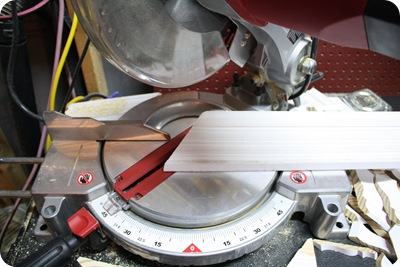
You�ll notice the left of the molding on the saw is really the right side, and vice versa (because the back is facing you).

That�s it. Seriously, I waited how many years to figure this out? Here�s how your molding will look for an inside corner:

Notice you can see the edges of the wood? You want to see that, so when they go together up in the corner, they�ll meet up like this:

That�s the only tricky part, getting that angle right as you�re working around the room. You do want the back of the molding to be the longer edge, not the front:

Does that make sense? That part is huge! For an inside corner, it just won�t meet up the other way.

Installation is EASY � you�ll just need someone to help you hold up the pieces as you nail them in (thanks Dad!!).

I used our nail gun and nails that were just over an inch long:

I put nails in the bottom of the molding every 18 inches or so, and you�ll want to get them into a few studs along the way. I don�t worry about that too much � crown isn�t too heavy (typically), so as long as  you get nails in a few studs you�ll be good. I also put some through the top (into the ceiling) as well, just to secure it a bit more.

Something to think about as you have the molding on the saw is to watch how it rests. If you have it at this angle for one cut:
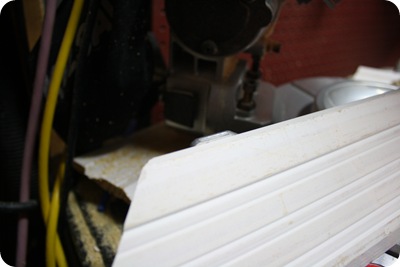
Make sure it�s not lower like this:
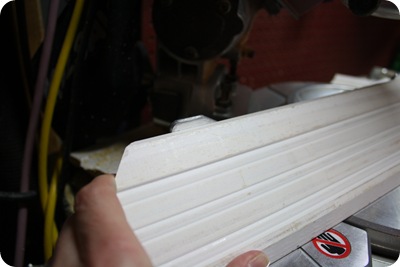
Or this:
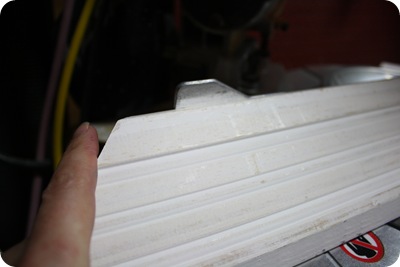
For the other cuts. It will change how the molding meets in the corners.

If you do it (fairly) right, you�ll end up with this:

inside corner with crown

Don�t worry about it being perfect!! More on that in a bit!

One thing that�s held me back from figuring this out in the office was the weird angles at the doorway:

But we quickly figured out it was the exact same cuts, just at a 22.5 degree angle:

So, overall, this was WAY easier than I thought it would be. But, as always, I ran into issues I figure you all will too. So I want to mention them. So you don�t hate on me when you try it. :)

I�ve mentioned before that when you pick out molding, you�ll want to make sure it lays flat against the floor. Any pieces that are slightly bent or wackadoodle will give you issues when you install them.

I knew one of mine was slightly off and used it anyway, and wish I wouldn�t have. Because it was bowing, it looked like this when I got it up:

See the eleventy billion holes? Yeah. That�s me trying to get it to go flush against the wall. It wasn�t. :) There was no stud at the point where there was an issue, the nails just weren�t grabbing anything. So I was left with a spot that didn�t match up perfectly.

I could have just taken it all down, cut a new piece and reinstalled everything. But I don�t roll like that. I hide, hide, HIDE all the imperfections I can. :)

Also, if you don�t have a piece long enough for a whole wall, you�ll need to meet up two � which is why I cut the crown at an angle above. Supposedly an angled cut hides more than a straight one � that�s what I�ve heard anyway. I�ve done it both ways, and over time, both need to be touched up as things settle.

So basically, do what you want. :)

That brings me to my next point � caulk is your BFF. Don�t fret if it looks like patoot after you install everything. Caulk and putty cover a multitude of sins. Here�s that same spot with caulk covering the nail holes and the crack:

When I paint, it will cover it up even more. Most people will never notice it. MOST. :)

You can see how the bowed piece didn�t meet up with the wall perfectly on the bottom:

gaps in crown

Can you see the gap? I�ll caulk it so you won�t even notice it. Or maybe I won�t. :) It doesn�t bother me too much, but that�s me.

Finally, I was thisclose to done with the room, when I finished up the last corner � and the two corners didn�t match up. You need to make sure the angles of the crown (how it fits on the wall) are exactly the same as you go around. Does that make sense? If you are slightly off in the way you hold it up and install it, it won�t match up perfectly at the corners, no matter how well you miter those corners.

Again�CAULK IS YOUR BEST FRIEND. Serious. Remember, crown is up high. Way above your head. People can�t see the itty bitty imperfections. Only YOU do. Trust me. :)

So, for now, it�s done. My plan was to install a skinny trim an inch or two down from the crown, then paint it all out white (this gives the illusion of chunkier molding), but I�m going to wait to see how it looks with all of the board and batten before I do that.

By the way, doing that would hide even more imperfections. :)

Here�s the end result!:

   

installing crown molding

OH my, what a difference!! Isn�t that crazy?

Goodness, I LOVE MOLDING!! :)

So here�s my before and after for the month � the office before crown:

And after!

(Don�t worry � the cord will be hidden by the beautiful drapery fabric.)

I hope my pictures and instructions help and don�t make you more confused! Keep in mind, I only had to do inside corners. I haven�t had to attempt the outside versions yet. :)

And YES, you can do this with an $8 miter box and a hand saw, and YES, you can install crown with regular nails and a hammer. (I�ve done both in our dining room.)

It will just take you a bit longer to get to the finished product. :)

I can�t wait to see your before and afters for the new year! Remember, be sure to link up to your post, not your blog! And you�re welcome to add this purdy little button to your post:

beforeAndAfterButton

Thank so much! Link it up Squeezays!!

Factories Expand 17 Consecutive Months, Jobs Don't

The latest ISM reports show Factories grow for 17th straight month in December.
Manufacturers produced more goods and booked more orders last month, leading to the fastest growth in factory activity since May.

The Institute for Supply Management said Monday that its index of manufacturing activity rose to 57 in December from 56.6 in the previous month. Any reading over 50 indicates growth. The latest is well above the recession's low of 32.5, hit in December 2008. But it's below the reading of 60.4 in April, the highest level since June 2004.

The report shows that manufacturers carried considerable momentum into the new year. Automakers, computer and electronics companies, and industrial machinery firms showed particular strength, the Tempe, Ariz.-based ISM said.

A survey of Chinese manufacturers last week showed that nation's boom lost a bit of momentum last month. The HSBC China Manufacturing Purchasing Managers Index slipped to 54.4 in December from 55.3 in the previous month, a three-month low. Still, the number indicates China's factories are increasing output.

In the U.S., export orders are still growing, the ISM said, but at a slower pace. ISM's index of export orders was 54.5 in December, down from 57.

A big question for this year is whether the growth will translate into more hiring. According to the ISM, manufacturers are adding jobs, but at a slower pace. Its employment index fell to 55.7 from 57.5. But the ISM's employment index hasn't always been very reliable: the manufacturing sector has actually shed small numbers of jobs for the past four month, according to the Labor Department.
Manufacturing Employment

The BLS Current Statistics report shows November lost 13,000 jobs, October 11,000 jobs, September 6,000 jobs and August 26,000 jobs.

click on any chart below to see a sharper image


In spite of 17 consecutive months of manufacturing expansion, hiring was only up 7 of those months, and not once in the last 4.

Manufacturing Long-Term Trends


The long-term trend suggests it would be a mistake to expect too many jobs out of manufacturing.

For more about jobs please see Jobs Forecast 2011 Calculated Risk vs. Mish

The BLS report for December comes out on January 7th. The January report comes out on February 4th. Those reports could be robust because of retail and service sector hiring, especially the January report.

Normally there are a lot of layoffs in January for obvious seasonal reasons. However, some of the recent hiring by stores might be permanent. If so, some expected layoff may not happen and we could see a couple of really nice looking jobs reports.

However, it would be a mistake to think that stores are going to keep hiring at a brisk pace all year simply because a couple of months look good. Headwinds are enormous and the mess states face is not accounted for. We are not going to spend our way back to prosperity regardless of what Keynesian clowns may think.

Mike "Mish" Shedlock
http://globaleconomicanalysis.blogspot.com
Click Here To Scroll Thru My Recent Post List

Uniquely Dysfunctional Relationships; Short and Long-Term Solutions to the Public Union Pension Crisis

"Uniquely Dysfunctional" is an apt description of the relationship between public unions and the corrupt politicians in bed with those unions. The term comes from Fred Siegel, a historian at the Manhattan Institute.

I found the term in Public Workers Face Outrage as Budget Crises Grow.
Ever since Marie Corfield�s confrontation with Gov. Chris Christie this fall over the state�s education cuts became a YouTube classic, she has received a stream of vituperative e-mails and Facebook postings.

�People I don�t even know are calling me horrible names,� said Ms. Corfield, an art teacher who had pleaded the case of struggling teachers. �The mantra is that the problem is the unions, the unions, the unions.�

It is an angry conversation. And a growing cadre of political leaders and municipal finance experts argue that much of the edifice of municipal and state finance is jury-rigged and, without new revenue, perhaps unsustainable. Too many political leaders, they argue, acted too irresponsibly, failing to either raise taxes or cut spending.

Fred Siegel, a historian at the conservative-leaning Manhattan Institute, has written of the �New Tammany Hall,� which he describes as the incestuous alliance between public officials and labor.

�Public unions have had no natural adversary; they give politicians political support and get good contracts back,� Mr. Siegel said. �It�s uniquely dysfunctional.�

In California, pension costs now crowd out spending for parks, public schools and state universities; in Illinois, spiraling pension costs threaten the state with insolvency.

And taxpayer resentment simmers.

A white-haired retired undercover police officer, whose wrap-around shades match his black Harley-Davidson jacket, pauses outside the Washington Township municipal building to consider the many targets. He did not want to give his name.

�Christie has all the good intentions in the world but has he hit the right people?� he says. �I understand pulling in belts, but you talking about janitors and cops, or the free-loading freeholder?�
Among the freeloading freeloaders are the cowards like the retired undercover police officer refusing to give their name to the New York Times. I would like to see that person's name and their pension payment posted in the article.

One would think that New Jersey teachers might have the ability to learn. However, judging from repeated powder puff softball questions by teachers that governor Chris Christie can hit out of the ballpark, I have to wonder.

Marie Corfield got what she deserved. Check it out in case you think otherwise.


Governor Chris Christie was straight, direct, and correct in his response to a union teacher in New Jersey who complains about teacher layoffs. Clearly the teacher's union is to blame.

Moreover, it is the same in every state. How teachers cannot see this is a wonder to behold.

For all I know, Marie Corfield is a hard working teacher. However, I can make a case we do not need to teach art at all, and on that basis she should be fired tomorrow.

However, the merits of teaching art is not the point. The point is her amazing sense of entitlement as to what her job is worth as a teacher in general. The same applies even more so to police and fire workers whose pensions are generally larger.

Bankruptcy Solution

One possible solution to this madness in my opinion is bankruptcy. In bankruptcy, the teachers and fire fighters and police can see just what a judge thinks they are worth. My point being, you cannot pay money that is not there.

In many case, city finances are so far gone that bankruptcy is the only option

Amazing Sense of Entitlement

Taxpayers are angry and for good reason. Many do not have the "problem" Marie Corfield bitches about because their problem is worse, no job at all.

While Corfield whines about having to pay $750 dollars a year for family health, dental, and eye-care (for life), most pay far more for far less. Many have no benefits at all.

Where this insane sense of entitlement come? The only possible answer is the union itself. Private workers certainly do not have the same sense of "taxpayers owe me" entitlement that public union members have. That entitlement comes from being part of a union "mob".

These public union-politician "dysfunctional relationships" are fraudulent precisely because there is "no natural adversary", no one looking out for taxpayer interests.

Short and Long-Term Solutions

The long-term solution is the end of collective bargaining for public unions, and indeed the total abolishment of public unions in general.

Unfortunately that does not rectify the ill-gotten gains of public union workers, notably police and fire workers who often retire at age 55 with 80-90% of salary and take another job in the meantime.

The short-term solution to this mess is to tax all public union pension benefits before the age of 62 at 90% , and after the age of 62, tax public union pensions in excess of a certain amount at a very high rate.

I propose these taxes be collected upfront, taken out of retirement checks and the money collected be fed back into public union pension plans to make them solvent. The beauty of my proposal is it could win support of many public union workers who do not have excessive benefits and who might be totally screwed in bankruptcy.

Mike "Mish" Shedlock
http://globaleconomicanalysis.blogspot.com
Click Here To Scroll Thru My Recent Post List

The Consumer Becomes "The Consumed"

Following is one of the more fascinating emails I have ever received. It is from reader Sally Odland who every year partakes in a "different ritual" celebration on New Year's Eve, a tradition she picked up on a trip to Ecuador.

Sally writes ...
Dear Mish,

I can't thank you enough for writing your blog. It's become my go-to stop for rational economic analysis.

Thought you might enjoy these photos of another kind of New Year's celebration....a tradition we picked up on a trip to Ecuador.

Each New Year's Eve, our family explores the detritus of the last week to reveal the essence of the departing year. From trash emerges the effigy of the passing year, which we burn at the stroke of midnight.

This year's cornucopia of discounted personal luxury ads embodied the illusionary idea that we can (must!) buy our way to economic health. In doing so, the consumer becomes "The Consumed".

Wishing you true prosperity in 2011.

Sally Odland
Croton-on-Hudson, NY
click on any image for a sharper view


I feel obliged to point out the exceptionally funny fine print "Once In A Lifetime" just above the words "Twice Yearly Sale" in the second and third photos.

Sally Writes ...
Effigy was collaborative montage assembled - literally - at the 11th hour by me, my husband Bruce, sons Max and Michael and Max's girlfriend Susannah. My sons laid the fire. Photos shot by Bruce.

Face was cut from NY Times Magazine issue "The Lives They Lived". It is Philippa Foot, moral philosopher, author of "Natural Goodness".

Her face was the right size and shape. However, her philosophy is strangely relevant to the theme.

From the article: She "became troubled by a central assumption of 20th-century moral philosophy: that facts and values are logically independent."

Sally
The Trolley Problem

Please consider the New York Times article Philippa Foot, Renowned Philosopher, Dies at 90
Philippa Foot, a philosopher who argued that moral judgments have a rational basis, and who introduced the renowned ethical thought experiment known as the Trolley Problem, died at her home in Oxford, England, on Oct. 3, her 90th birthday.

In 1967, in the essay �The Problem of Abortion and the Doctrine of the Double Effect,� she discussed, using a series of provocative examples, the moral distinctions between intended and unintended consequences, between doing and allowing, and between positive and negative duties � the duty not to inflict harm weighed against the duty to render aid.

The most arresting of her examples, offered in just a few sentences, was the ethical dilemma faced by the driver of a runaway trolley hurtling toward five track workers. By diverting the trolley to a spur where just one worker is on the track, the driver can save five lives.

Clearly, the driver should divert the trolley and kill one worker rather than five.

But what about a surgeon who could also save five lives � by killing a patient and distributing the patient�s organs to five other patients who would otherwise die? The math is the same, but here, instead of having to choose between two negative duties � the imperative not to inflict harm � as the driver does, the doctor weighs a negative duty against the positive duty of rendering aid.

The philosopher Judith Jarvis Thomson added two complications to the Trolley Problem that are now inseparable from it.

Suppose, she suggested, that the bystander observes the impending trolley disaster from a footbridge over the tracks and realizes that by throwing a heavy weight in front of the trolley he can stop it.

As it happens, the only available weight is a fat man standing next to him. Most respondents presented with the problem saw a moral distinction between throwing the switch and throwing the man on the tracks, even though the end result, in lives saved, was identical.

The paradoxes suggested by the Trolley Problem and its variants have engaged not only moral philosophers but neuroscientists, economists and evolutionary psychologists. It also inspired a subdiscipline jokingly known as trolleyology, whose swelling body of commentary �makes the Talmud look like CliffsNotes,� the philosopher Kwame Anthony Appiah wrote in his book �Experiments in Ethics� (2008).
Global Progression of "Being Consumed By Consumption"

Philosophical pontifications aside, it is fascinating to watch the global progression of "Being Consumed By Consumption".

The property bubble in the US, Ireland, and Spain took its toll. Yet, "It's Different Here" thinking runs deep in Australia, Canada, and China.

It's not different anywhere.

Once home prices exceed people's ability to pay for them and/or home prices exceed the cost of renting, crashes are all but inevitable. I do not care what commodity prices are or how many people allegedly want to move someplace (think Miami, Phoenix, Las Vegas, Vancouver, Sydney, Shanghai), home prices exceeding rental prices or wage growth by multiple standard deviations is a sign of a bubble that will pop.

Miami, Phoenix, and Las Vegas have seen crashes. So will Vancouver, Sydney, and Shanghai. Indeed, the longer the delay, the bigger the crash.

The warning signs of over-consumption in Australia, Canada, the UK, and China are flashing red. However, it's far to late to do anything about them. The interest rate match has been lit in Australia and China, but it is irrelevant.

Interest rates hikes or not, global property bubbles and consumerism in general are going up in flames just as the trash of reader Sally Odland did at the stroke of midnight on new year's eve.

Happy New Year


For a look at problems for the new year, please see Ten Economic and Investment Themes for 2011

Mike "Mish" Shedlock
http://globaleconomicanalysis.blogspot.com
Click Here To Scroll Thru My Recent Post List
 
Copyright 2010 Camera Dashboard. All rights reserved.
Themes by Ex Templates Blogger Templates l Home Recordings l Studio Rekaman