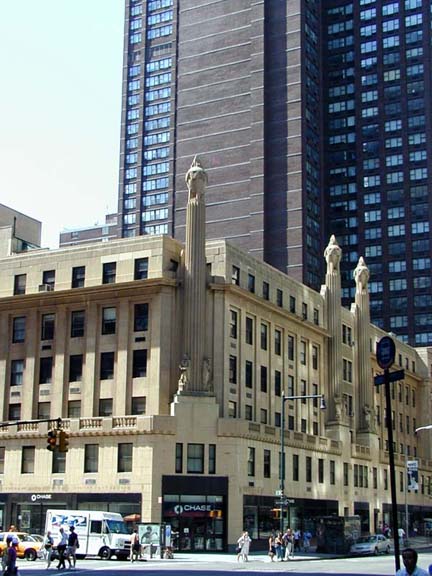
Brise by digdoi.
Detail of the Biennal Pavillion in S�o Paulo, Brazil by Oscar Niemeyer.
To contribute your Flickr images for consideration, just:
:: Join and add photos to the archidose pool, and/or
:: Tag your photos archidose
:: Join and add photos to the archidose pool, and/or
:: Tag your photos archidose
"I was at a meeting this morning where someone said, 'Look, we need $150 billion just for infrastructure and transportation.' It's true," Schwarzenegger told Reuters in an interview in a state office in San Francisco.This is so staggering that all I can do is repeat the sound bytes.
"We need $500 billion to rebuild California the way it ought to be," he added. "But this is of course too big for people to digest, so you don't talk about that."
Speaking about the total of $42.7 billion in general obligation bonds authorized by voters last year for public works spending, Schwarzenegger said: "This was only the foot in the door, to whet the appetite."
In the short term, Schwarzenegger acknowledged California could face lower tax revenues than projected in his January budget plan, but said he opposed new taxes.
"We have done tremendously with the revenue increases, but we do not want to do a tax increase."
He said he does not expect California to issue less debt if the economy slows. "I don't think we have to do that," he said.


1. Hire Norman Foster.
2. Sit back and wait while Lord Foster channels R. Buckminster Fuller and designs a "diagrid" exterior wall.
3. Land the new 46-story tower on and in a 1928, six-story historical landmark, but be sure to keep the existing, two-dimensional exterior walls and clean 'em until they look like a molded plastic model.
4. Don't bother to give the building any sense of entry, and go ahead and make the grand lobby space inaccessible to the public while you're at it.
5. Market the sustainable aspects of the tower to gloss over its ugly and hulking presence on the skyline.
Uncle Fred is pleased to announce that effective September 1, 2007 we will cease buying subprime mortgages that have a high likelihood of excessive payment shock and possible foreclosure. Our goal is not really to protect consumers from default, but rather our goal is self preservation. We want to protect ourselves against massive losses that other lenders are seeing.As stated at the outset, the above article is purely fictional. No one really knows what any of these lenders were thinking when collectively the subprime mess was allowed to get out of hand as it did. What we do know is that corporations are reacting after the fact. We also know that it took over 20 subprime lenders to blow up before some companies reacted at all. This is not a slam directed specifically at any particular lending institution per se but rather a satirical look at the entire mortgage lending business.
Second, the company will limit the use of low-documentation underwriting for these types of mortgages to help ensure that future borrowers have the income necessary to afford their homes. Why we allowed such loans in the first place can be summed up in one word: greed.
We will implement these new investment requirements for mortgages originated on or after September 1, 2007 to avoid market disruptions (such as a sudden hit to loan volume) which might cause investors to panic.
To help lenders better serve borrowers with impaired credit, Uncle Fred is also developing fixed-rate and hybrid ARM products that will provide lenders with more choices to offer subprime borrowers. We are doing this to not as a favor to anyone but in desperate hope of keeping volumes going. Honestly, we don�t think this will work, but what else can we do?
Uncle Fred continues to play aleadinglagging role in combating predatory lending and putting families into homes they can afford and keep. Proof is in the pudding. We let subprime abuse continue for years and did nothing about it. We took the loans knowing full well they were garbage. Simply put, we wanted our fair share of the graft. But in the wake of 27 subprime lenders blowing up, the market forced us to react. Better late than never we always say.
Uncle Fred�s new requirements cover what are commonly referred to as 2/28 and 3/27 hybrid ARMs, which currently comprise roughly three-quarters of the subprime market. Specifically, the company is requiring that borrowers applying for these products be underwritten at the fully- indexed and amortizing rate, as opposed to the initial "teaser" rate. Quite frankly we got tired of being a tease, not for moral reasons, but out of fear for our stock options.
We will no longer purchase "No Income, No Asset" documentation loans and will limit "Stated Income, Stated Assets" products to borrowers whose incomes derive from hard-to-verify sources, such as the self-employed and those in the "cash economy." Obviously we should have done this long ago. Honestly, we really don�t know what we were thinking. If you know what we were thinking, please tell us.
In addition, Uncle Fred will require that loans be underwritten to include taxes and insurance and will strongly recommend that the subprime industry collect escrows for taxes and insurance, as is the norm in the prime sector. Because the maintenance of escrow accounts is not widely used in the subprime sector, Uncle Fred does not believe it is practical to unilaterally mandate it as a purchase requirement at this time. This is consistent with our policy to be a market follower and to react only when the market forces us to.
"Escrowing for taxes and insurance clearly provides an added layer of consumer protection. It is our hope that this universal practice in prime lending today becomes the universal practice in subprime lending tomorrow.� We reduced to hoping that someone does what needs to be done while we wait for that to happen.
Our official policy is clear:
"There�s no time like the future to do what we think needs to be done today".
Uncle Fred apologizes for its role over the last few years in failing to prevent predatory lending and rising foreclosures. From now on (and we mean it this time� maybe) the following polices will beenforcedstrictly encouraged:Finally we would like to wash our hands for our role in the ongoing housing collapse. We are doing that with superficial programs such as FredSmart�, and Don�t Borrow Trouble. We readily admit that such programs will be about as effective as warning teenagers about premarital sex but what the heck? These catchy sounding programs just might stop a lawsuit sometime down the road.
- refusing to do business with institutions that engage in predatory lending practices (except of course we are willing to overlook such things like enormous prepayment penalties for up to 3 years)
- not investing in mortgages that require mandatory arbitration (except for major homebuilders like Lennar, KB Homes, TOL, and well everyone else too... at our at our discretion of course)
- refusing to invest in high-rate or high-fee mortgages as defined by the Home Ownership and Equity Protection Act of 1994 (HOEPA), as well as mortgages with single-premium credit insurance or subprime mortgages with prepayment penalty terms of more than three years. Three years is all our conscious can bear at this point in time. Besides, three years covers almost all of these offerings anyway. This makes it look like we are really doing something when we aren't. Prepayment fees are very lucrative. We don't want to shut off that gravy train prematurely.
- requiring that lenders provide complete credit information about borrowers to all the credit bureaus and reporting agencies (This requirement is so basic that it should be a given. But we needed to pad our bullet point list a bit).
Uncle Fred is a stockholder-owned company established by Congress to support homeownership and rental housing. Uncle Fred fulfills its mission by purchasing residential mortgages and mortgage-related securities, which it finances primarily by issuing mortgage-related securities and debt instruments in the capital markets.
Our new truth in lending policy requires us to point out that these debt instruments are often packaged as AAA government bonds (even though they shouldn't be rated AAA nor are they really government bonds in the first place). We sell these debt instruments to unsuspecting pension plans, hedge funds, and foreign investors who do not fully understand the risks of a housing implosion (and/or are simply too greedy to care).
Over the years, corporate insiders at Uncle Fred have profited tremendously from our quasi-government relationship. We are acting as best we can to smooth earnings (and with regulators breathing down our necks this is getting more difficult every passing day). We hope that superficial announcements like this will keep our stock prices high, stock options flowing, and insiders (us) happy.
Now even mainstream media and mainstream analysts regularly speak of the sub-prime �meltdown� or �carnage� and refer to these sub-prime mortgages as �garbage� or �trash�. Since most of these sub-prime mortgages were junk that should have never been originated in the first place, now the new spin in financial markets is to minimize the nature of the problem by making two arguments: first, sub-prime loans are only a very small fraction of the housing market, specifically only 6% of it; second, sub-prime problems are a niche problem that is not affecting other parts of the mortgage market. Both arguments are utter spin without any basis. Let us see why.From the above, it is clear that the barn doors are being
Where did the Mortgage Bankers Association (MBA) get the �sub-prime is only 6%� figure that it is spinning around in every possible media? Their trick is to consider all homeowners, even the 35% of homeowners who do not have any mortgage and then argue that only 6% of homeowners are sub-prime borrowers. Why is this spin and why is the actual figure for �garbage� mortgages actually closer to 50% of the flow of new mortgages in 2005-2006 rather than the �6%� being spinned around?
Let me elaborate:
- Sub-prime are now 13% of the stock of mortgages, not 6%.
- Sub-prime mortgages were at least 20% of mortgage originations in 2005 and 2006.
- The same �monster� lending practices used for subprime mortgages were also used for most �near-prime� and �prime� mortgages.
- Many pseudo �near-prime� mortgages (such as Alt-A) are undistinguishable from sub-prime ones and have now sharply rising default rates
- What is defined as sub-prime is subject to highly cosmetic accounting by banks: the rule that FICO scores of 660 or below are sub-prime is often diluted down to 630 or even 620 to exclude many mortgages from a sub-prime classification.
- Counting all of the categories above, subprime-like mortgages accounted for almost 50% of all originations in 2005 and 2006 not the 6% figure spinned by the industry lobbies.