Tuesday, October 3, 2006

Falling Dominoes

The Sentinel is reporting State targeting abusive lenders.
The [Massachusetts] state Division of Banks is cracking down this month on what it sees as abusive business practices by mortgage lenders and brokers.

The agency issued a series of new emergency regulations earlier this month, requiring better documentation from lenders and prohibiting them from pressuring consumers into taking out mortgages they can't afford or working without their own independent lawyers. It also forced four companies -- two of them located Worcester -- to close immediately and place all pending mortgages with another, more established lender.

Commissioner of Banks Steven L. Antonakes said in a recent interview that division examiners found a pattern of deceptive business practices by some lenders during their most recent round of company inspections.

"We want to spell out in very plain English to send a message to lenders and brokers that these specific acts, whether they're very obviously unfair or deceptive, or more subtle, they weren't going to be tolerated," he said. "And you would put your license at risk by engaging in this kind of activity."

Abusive lending practices can destabilize the entire real-estate market. As an example, he described a hypothetical street containing 10 homes, each worth a certain amount of money.

"If loans were originated for two of those homes, in which the loan was made that the broker knows the consumer has no hope of repaying those loans, very likely the borrower will become delinquent," he said. "In the worst case, the home will be foreclosed upon, and that kind of activity could result in the home being sold for less than its value and before you know it, you have a domino effect."

But the slowdown has also put lenders in a tough position, said Christopher J. Iosua, president of the Mortgage Connection Inc. "When business slows down the way it has in the past six to nine months, new loan originators and those without a strong base of customers do things they probably wouldn't normally do," he said.
The idea that lenders are doing things they may not have done in "normal conditions" may have some merit for some lenders but when 40% of the loans sold in California before the bust started were either stated income loans or pay option arms, I think the idea is more fiction than fact. Anything and everything was done to keep the bubble booming, and that was happening well before the bust.

With every bubble comes fraud. The two go hand in hand and housing is not unique in this respect. We are only beginning to scratch the surface of the fraud that supported this bubble. Lending standards are going to tighten as a result, and will continue to tighten as more and more of the fraudulent activity is exposed. I consider fraud and tightening of lending standards to be two big dominoes that are now falling. Tightening of lending standards was previously discussed in Lending Guidelines / Credit Squeeze and The Blame Game.

Consumer Spending

Consumer spending has been propping up our economy for so long so let's take a look at the current state of affairs with that oversized domino. The associated Press is reporting Consumers Cut Back Spending in August.
Feds Say Consumers Cut Back Spending by 0.1 Percent in August, Largest Amount in Nearly a Year.

WASHINGTON (AP) -- Battered consumers, faced with weak income growth and rising inflation, trimmed their spending in August by the largest amount in nearly a year. The Commerce Department reported Friday that consumer spending, after adjusting for inflation, dropped by 0.1 percent last month, the first decline since a 0.3 percent fall in September 2005, a month when business activity was disrupted by Hurricane Katrina.

Incomes, reflecting lackluster gains in employment, rose by just 0.3 percent in August, the weakest performance in nine months. Core inflation, which excludes energy and food, was up a worrisome 2.5 percent compared to a year ago, the biggest year-over-year increase in more than a decade.

The new report underscored how much the economy is slowing this year as consumers have been battered by record-high gasoline prices and a cooling housing market. Falling home prices are making Americans more cautious about spending money because they feel less wealthy.

The overall economy grew at an annual rate of just 2.6 percent in the April-June quarter, the government reported Thursday, and the new report on consumer spending indicates that growth will likely slow even more in the current quarter.

However, most economists believe the country will be able to escape an outright recession, in part because trends in recent weeks have been more favorable with gasoline prices falling rapidly, helping to boost consumer confidence.

That development is expected to bolster consumer spending in the final months of this year, giving retailers a decent Christmas sales season. Consumer spending is closely watched because it accounts for two-thirds of total economic activity.

Consumer spending before adjusting for inflation showed a tiny 0.1 percent rise, far below the 0.8 percent jump in the previous month.
Premature reports of the "death of the consumer" have been heard for quite some time now from various people, and I must admit that group includes me. Consumers have been spending more than they have been making for 16 consecutive months. We have seen our first yearly negative savings rate since the great depression. For a nice graph of the negative savings rate, as well as a neat picture of the mythical Eeyore please consider July Personal Spending.

Mortgage Equity Withdrawal

One of the dominoes propping up consumer spending is called Mortgage Equity Withdrawal. In simple terms people have been treating their house as a ATM, taking cash out at refinancing and spending it. That source of funding is drying up. CalculatedRisk talked about MEW in GDP Growth: With and Without Mortgage Extraction.

The recent Flow of Funds report showed that household mortgages increased $220.3 Billion in Q2 2006, and $436.4 Billion for the first half of 2006. Using a simple formulation(1) for Mortgage Equity Withdrawal (MEW), MEW was $81.6 Billion in Q2 2006. This is substantially below the record $180.1 Billion of MEW in Q3 2005.

CalcualtedRisk went on to say the "declining MEW over the next few years will be a significant drag on GDP growth." I agree. That falling domino makes it more likely that this downturn in consumer spending is finally the real deal.

Jobs

Another key domino that is tipping but has not completely fallen over yet is jobs. I recently wrote about Jobs in No Hard Landing. Following is a snip from No Hard Landing, quoting Mike Morgan of MorganFlorida (a Florida Real Estate Broker).
Will there be a hard landing? No!
Will there be a crash landing? Absolutely!

For the last two weeks I�ve been receiving daily calls from desperate mortgage brokers, real estate attorneys, insurance brokers, title companies and subcontractors looking for deals and work. This week I spoke with a real estate attorney closing his office and returning to the corporate world. And several of the smaller builders have called me offering triple commissions to entice sales of their inventory. It doesn�t end there.

Who will the housing crash effect? Everyone. Real estate agents will be first. As a group, they�ve made a ton of money during the housing boom, and they�ve spent millions on new cars, vacations, restaurants, clothes, and everything else that comes with excessive discretionary income. That�s over now. Agents are not buying the luxury items that helped feed the economic boom, and they are cutting back on business spending like advertising and marketing. That hits the vendors and newspapers revenues.

But this is all old news for us. The other shoe is dropping now. Loss of hundreds of thousands of jobs created from housing will act like a virus and spread throughout our economy. As real estate agents, attorneys and mortgage brokers reign in their spending, it will effect restaurants, car dealers, advertising companies, jewelers, remodeling contractors, furniture manufacturers, bank profits, electronic retailers, clothing and the list goes on and on and on.

As the primary players are affected, and they cut back on spending, so will the secondary players in this market. These companies will be forced to lay off employees, and the cycle will grow like a virus. Is that it? Not a chance.
The reason this domino has not completely fallen over yet is that homebuilders are still building homes at a high rate. Yes, year over year rates show huge declines, but homebuilding remains brisk on a historic basis. Thus homebuilding is still providing jobs even as it increases inventories and downward price pressure. So while housing related trade jobs are slowing, they have not yet collapsed. They will. It is just a matter of time.

Countrywide

The Ventura County Star is reporting Countrywide may cut jobs by 10%.
The end of the real estate market boom is forcing one of Ventura County's largest employers to cut 5 percent to 10 percent of its work force over the next few months, a top executive told workers Tuesday.

Countrywide Financial Corp., the country's largest mortgage lender with about 5,700 workers in Simi Valley, Thousand Oaks and Westlake Village, instituted a 60-day hiring freeze and plans to reduce staffing in several areas, Dave Sambol, president and chief operating officer, said in a memo obtained by The Star.

The memo does not mention layoffs, but several workers leaving the company's Westlake Village office as security guards roamed the parking lot declined to discuss layoffs or said they were told not to talk with the media.

layoff rumors that had been swirling on the Countrywide campus for weeks were confirmed Tuesday morning. "You found out because your vacation time on your paycheck was gone," said [a Thousand Oaks woman].

�Bloodbath levels of decline'

"Sales of single-family homes for the year through July were down 27 percent, condos are down 60," said economist Mark Schniepp of the California Economic Forecast Project in Goleta. "These are bloodbath levels of declines. I don't see how you can call that kind of a market healthy. There are direct casualties from this downturn."
I had the pleasure of talking to George Noory with CoastToCoast radio last Thursday evening. I briefly mentioned Countrywide while talking about housing. I was surprised to receive this Email the next day:
�Mr. Shedlock thank you for your presentation last night on Coast To Coast.

My husband has been a loyal employee of that company for five years. He has been in the mortgage and lending industry here for almost 20 years. He's had outstanding performance reviews and was recognized repeatedly for running a very profitable branch FOR COUNTRYWIDE.

Mid Summer without ANY WARNING whatsoever, and after years of outstanding performance reviews his branch was summarily closed. He and his production staff were RIFED, then BROUGHT BACK into a failing branch that had been recently started up just a few miles from his branch.

You see over the course of several years (and through an ever revolving door of Area Managers who were amply rewarded for OPENING NEW BRANCHES) his management had established offices within one or two miles of each other in the same footprint. This was fine during the boom times of low interest rates, but you can imagine the cannibalism for trained qualified staff and accounts that raised it head during times of ever increasing interest rates. Instead of working in concert with existing branch managers to establish a consolidation plan, SUDDENLY AND WITHOUT WARNING BRANCHES WERE SHUT DOWN employees were rehired with DEMOTIONS into cramped, tiny start up offices.�
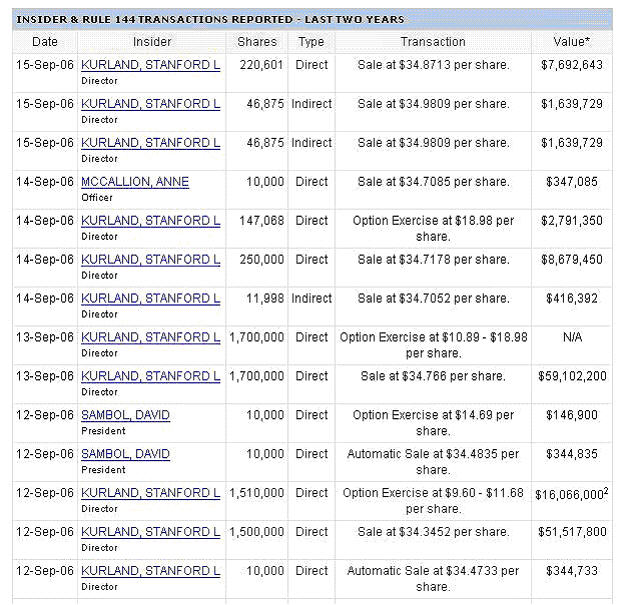
Countrywide Insider Sales


The above is just a snip of insider sales and it was taken mid-september. Here is a link to all recent insider transactions thanks to Yahoo. One look will show that CFC insiders are massively voting with their feet (making tens of millions of dollars in the process).

A National Bubble?

Is it just Florida, Boston, Phoenix, Las Vegas, and California affected by this? Even if it was, that would still be a lot wouldn't it? Let's look at California alone. CalculatedRisk reported back in May of 2006 California: Real Estate Licensees Surpasses 500,000. In other words, one out of every 55 adults in California is a RealEstate agent. That's a lot of jobs isn't it? The question to ask next is "How many of them have had any sales lately?" Technically they are still employed even though many agents in many states have no money coming in. The unemployment numbers produced by the BLS are a joke for many reasons and this is just one of them.

But returning to the initial question, the answer is no. This is not just affecting the coasts and the deserts but places like Minneapolis and Madison Wisconsin as well.

If you have not yet seen this video about Billings Montana, please take the time to play it. It is a stunning example of the overbuilding that still continues today in spite of sinking demand. It continues in all of the bubble markets as well. Condos and houses are still going up everywhere. Once that building stops, official unemployment rates will soar.

Retail Expansion

The falling domino from slowing homes sales will soon tip the domino of retail store expansion.

Retail expansion, primarily around new subdivisions going up in outer suburbia, supported a multitude of jobs at places like Pizza Hut, Bennigans, Outback Steakhouse, Walmart, and Home Depot. With the slowdown in housing activity, the slowdown in strip malls will follow with a lag. Retail store expansion is in its final phase.

Global Wage Arbitrage

But pressure on jobs is not just on manufacturing and housing. We are being hit from multiple angles. I wrote about teaching jobs in Outsourcing Homework and medical outsourcing in Medical Tourism, the Healthcare Fiasco, and the Healthcare Fiasco Continued.

As you can see, there are many dominoes in various stages of tipping. Right now it seems like we may be headed for a mass collapse all at once as opposed to a more linear progression of falling dominoes. In the meantime hardly anyone in the mainstream media seems to be able to see the recession that is headed our way.

Mike Shedlock / Mish
http://globaleconomicanalysis.blogspot.com/

Monday, October 2, 2006

Monday, Monday

My weekly page update:
missing image - image02sm.jpg
The Chicago Athaneum's 2006 American Architecture Awards.

Some unrelated links for your enjoyment:
GreenBean
A "news and discussion forum dedicated to reporting on built, in-progress, and unbuilt green building projects in Chicago." (added to sidebar under blogs::sustainability, via Palla Palla)

The Real Chicago
Lee Bey interviews Brad Lynch of Brininstool + Lynch

Gehry: The Contemporary Master
A new blog of all Gehry, all the time (added to sidebar under blogs::architecture, via architechnophilia)

Gold, Mortgages, & Bigger Things

I encourage everyone to listen to the keynote address at the Denver Gold Forum 2006 September 25 - 26, 2006 by Robert McEwen former Goldcorp CEO and Goldcorp's largest shareholder. This tip is thanks to Adam Michael who posted the link on Minyanville. Scroll down to the 12:00 NOON hour and click the audio play button.

The comments that follow are mine.

You will hear McEwen talk about Goldcorp, Kinross, Newmont and Barrick. He also talks about Wheaton River and Glamis. But that is not what McEwen's message is really about.

McEwen could just as easily have been talking about Countrywide Financial, Chorus Bank, Washington Mutual, Providian, Golden West, and Wachovia. Indeed, his keynote address (for those who really listened) has nothing to do with gold at all.

McEwen's Message is about
  • Corporate culture
  • Shareholder value
  • Growth at any cost
  • Management stake
  • Making shareholders smile
  • Perfect deals
  • Paying rent to shareholders
  • Losing sight of what's important
If you look at the above list you will see nothing that pertains to gold. Instead you will see a philosophic approach to managing a company, any company. McEwen also put together a video mocking the Goldcorp Glamis situation. Adam Michael noted that the Denver Gold Forum responded by suspending McEwen from future shows.

If one equates the Presidency to that of a CEO and taxpayers to shareholders, the proper conclusion is that McEwen (or someone like him) should not be running Goldcorp but the country. Instead we have a president that squashes dissent, continually squanders shareholder value, and mortgaged our future for a bunch of worthless IOUs.

McEwen's speech was about much bigger things than gold, but I wonder how many at the conference managed to hear the real message.

Mike Shedlock / Mish
http://globaleconomicanalysis.blogspot.com/

Sunday, October 1, 2006

A Major Disconnect

Mish Note: I wrote this last week and it was originally published by Whiskey&Gunpowder last Friday. The charts are slightly out of date (from the 25th), but in reality not much has changed since I wrote it. The important message is the conversation I detail below, especially the ideas presented by Minyanville professor Scott Reamer. Please listen to what Scott has to say. Here goes:

There was an interesting conversation on Minyanville on September 26th between Kevin Depew and Scott Reamer. Let's tune in.

Kevin Depew:

"You guys always seem bearish," someone wrote me last night. That's simply not true.
Frankly, it is extraordinarily difficult to make money betting against stocks. And I don't know of any Professors at Minyanville who are permanently bearish. If Minyanville seems bearish it's just by comparison to the always-bullish-all-the-time news that permeates the mainstream media that it just seems that way.

So far this morning all I've read are bullish stories. Everything is bullish. Here are some of the bullish things I've read this morning:
  • The decline in oil and gasoline prices is bullish because it helps the low-end consumer.
  • The rise in oil and gasoline prices, if it happens, is bullish. It shows good economic growth.
  • The price wars over generic drugs is bullish because it helps free up discretionary income for those retirees who tend to spend the most money on prescriptions.
  • The declining housing market is bullish because it dampens inflation and makes housing more affordable.
  • The "unexpected" recovery in the housing market, if it happens, is bullish because it furthers the "wealth effect."
  • Rising rates are bullish because that signals strong economic growth.
  • Falling rates are bullish because that helps drive mortgage refinancing and cushions ARM resets. A falling dollar is bullish because it makes exports more attractive.
  • A rising dollar is bullish because it makes imports less expensive.
Scott Reamer:

Data itself doesn't matter. It's the environment into which it is fed that matters. In this case, since we are seeing historic, record risk-seeking (bullishness/complacency) EVERYTHING is bullish or considered so. So ANYTHING people say or data that comes in - even the most bearish (like housing stuff or UPS, LEND, HRB etc) - is "bullish" because people are in that frame of mind. It's at such an extreme and it is THAT condition that appears to be nearing an important - critical - inflection point.

Of course, both lower and higher oil prices cannot be bullish together. Understanding that particular riddle comes from understanding that it isn't the DATA itself that matters - but the psychological environment into which it is fed that matters. And THAT is the environment which you should be trying to measure and analyze. Not the data.

Mish:

When everything is bullish or everything is bearish you have the makings of a major disconnect. But context is important too. When stocks no longer fall on bad news or when stocks stop rising on good news a major turning point is often at hand. At such turning points the market will typically lead the data, sometimes by months. In the current situation stocks have been pretty much rising for three months on about any news. Had this happened after an enormous decline or deep into a recession it would likely be signaling a reversal.

We have now gone three years without so much as a 10% downward correction in the S&P. Although the markets may be signaling something, what exactly is it? Is this a replay of the 1994 goldilocks scenario? Looking at the stock market in isolation one might easily arrive at that conclusion. A look at treasuries, commodities, the relative performance of the S&P vs. the Russell Smallcaps, and a look at the DOW vs. the DOW Transports paints a different picture. Let's look at some of the concurrent data.

Yield Curve
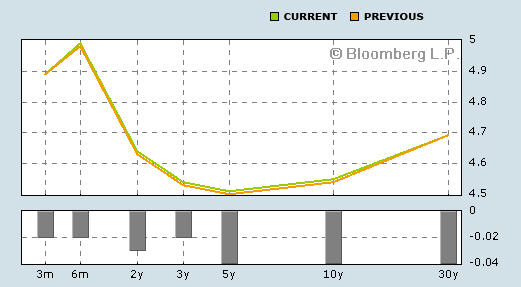
Here is the yield curve as of 2006-09-25


Currently there is a 67 basis point spread between the Fed Funds rate and the 10 year treasury. That is a quite steep inversion and one in which lenders should have trouble borrowing short and lending long, especially on mortgages.

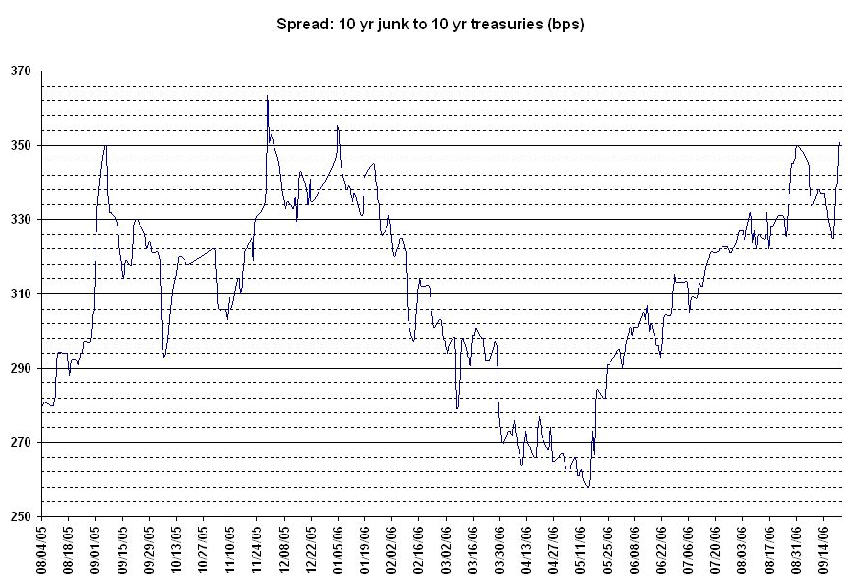
Here is a chart of junk bonds spreads vs. treasuries.


The above chart was produced by Orkrious on Silicon Investor who plots the data every day. As you can see, credit spreads have been widening since May. That is typically a sign of stress (at least in the long term presuming the trend continues). Such a trend is generally not good for stocks (to put it mildly).

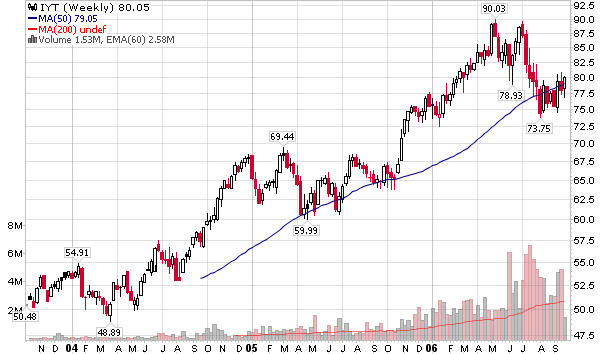
Please consider the DOW vs. the DOW Transports.

DOW


Transports


The DOW is about to make a new multi-year high while Transports are nowhere close.
In DOW theory that is a bearish divergence.

Homebuilders

Remarkable complacency is being shown in warning after warning after warning from homebuilders. At least with homebuilders one might have expected a snapback rally based on sentiment. Indeed bears had a warning when the builders stopped falling on bad news. But homebuilders rising for months on repeatedly bad news sure seems like another disconnect.

Check out Lennar's Third Quarter Lennar Reports Third Quarter EPS of $1.30

Financial Highlights
  • Revenues of $4.2 billion - up 20%
  • EPS of $1.30 - down 37%
  • Gross margin on home sales of 18.7% - down 760 basis points
  • Gross profit on land sales of ($0.3) million - down $46.7 million
  • Financial Services operating earnings of $61.7 million - up $26.8 million
  • Homebuilding debt to total capital of 31.9% - 520 basis point improvement
  • Return on equity of 25.2%
  • Deliveries of 13,038 homes - up 19%
  • New orders of 11,056 homes - down 5%
Here are the three things that most stand out.
  1. Gross margins are down 760 basis points to 18.7%. That is a staggering decline.
  2. Gross profit on land sales is now negative. Lennar is unloading land and/or options which shows lack of confidence going forward.
  3. Financial Services Operating Earnings had a 77% increase (from 34.9 to 61.7). To what extent is Lennar taking on risk (keeping the loans) just to unload houses?
How long will it be before Lennar's gross margins go negative?

Let's now consider the pool business.
Reuters is reporting Pentair cuts profit forecast on weak pool business
Saying that weakness in the housing market was taking a toll on its swimming pool equipment business, diversified manufacturer Pentair Inc. (PNR) on Tuesday cut its earnings outlook for the third quarter and full year, and said it was taking steps to cut costs.

Pentair, which also makes fluid-handling systems and industrial products, said it would earn between 30 cents and 32 cents per share in the third quarter, including a charge of about $17 million, down from its previous estimate of 46 cents to 50 cents.

Pentair also lowered fourth-quarter guidance to a range of 33 cents to 35 cents from 53 cents to 59 cents, resulting in full-year guidance from continuing operations at $1.72 to $1.76 a share. Analysts polled by Reuters Research predicted $2.07 per share for the year.

"This adjustment reflects the effect of the housing slowdown on spa and bath markets and on new pool starts," said Randall Hogan, Pentair chairman and chief executive officer.

Pentair said Charles Brown had stepped down as president and chief operating officer of its Pump and Pool & Spa units.
Enquiring minds might be wondering about home improvements. MarketWatch is reporting Lowe's cuts profit estimate to lower end of forecast
Home-improvement-goods retailer Lowe's Cos. said it now expects profit for the year that's toward the lower end of its prior view, citing consumer pressures such as a lackluster housing market and high energy costs, and it conceded Tuesday that it expects weakness to continue into next year.

In a Tuesday presentation to analysts and investors, Chief Financial Officer Robert Hull said he's seen the home-improvement customer pull back over the last few months, but the company has been looking into other high-margin growth areas as a way to boost profit and gain market share.

The slowdown in the housing market has been a concern for home-improvement retailers. They'd been ringing up robust sales in recent years as a booming real-estate market and low interest rates encouraged consumers to refinance mortgages or take out home-equity lines of credit to remodel. Competition from rival Home Depot Inc. and regional players has also intensified.

Last month, Lowe's shares fell after the retailer reported second-quarter earnings that missed Wall Street's outlook. At that time, Lowe's also cut its full-year profit forecast, citing pressure on consumer spending from higher energy prices and a slowing housing market.

Goldman Sachs analyst Matthew Fassler wrote in a note to clients. "Management's earnings guidance in the midst of flagging sales is credible. ... Moreover, we expect aggressive expenses control."

[Peter Benedict, Wachovia stated] "We believe there is still risk that more estimate reductions are ahead given there is no sign of the housing market reaching a bottom."
Generally a second warning or miss is a kiss of death but Lowe's rose slightly today. While Wachovia believes (as do I) "there is no sign of the housing market reaching a bottom", for now anyway, the market simply does not care. More interesting to me is the comment by Goldman: "We expect aggressive expenses control." Aggressive expense control huh? How many layoffs are we talking about anyway?

Speaking of layoffs, Haver is reporting Mass Layoffs Up.
September 21, 2006
  • In August, the number of mass layoff events rose for the third consecutive month. The 6.0% m/m increase pulled the y/y comparison positive for the first time since December.
  • During the last ten years there has been a (negative) 85% correlation between the three month average level of layoff announcements and the y/y change in payroll employment.
  • The number of persons affected last month by mass layoffs surged 11.4% m/m but were up just 0.3% y/y. The number of persons affected by mass layoffs during the first eight months of this year fell 12.6% from the first eight months of 2005.
  • Increased layoffs in manufacturing (21.2% y/y) and information (-35.0% y/y) dominated the increase in claimants for unemployment insurance last month. Declines elsewhere were widespread.
Mass Layoff Comments
  1. Mass layoffs are heading back up after falling for quite some time.
  2. The 85% correlation suggests unemployment will rise
  3. Layoffs were in manufacturing and information.
  4. Housing and retail related layoffs are not part of the picture, not YET anyway.
Long Summary
  • A hugely inverted yield curve is suggesting a recession
  • Mass Layoffs are increasing
  • Unemployment is expected to rise
  • Home builder margins are rapidly shrinking
  • Everything related to housing seems toxic
  • Credit spreads are widening
  • Commodities are dropping
  • Bankruptcies and foreclosures are rising
Short Summary
  • "We are seeing historic, record risk-seeking (bullishness/complacency) where EVERYTHING is bullish or considered so." (Mish note: except for commodity prices themselves and commodity related stocks).
  • The stock market is priced for a "Goldilocks" scenario, if not better.
Final Thoughts
  • There is obviously a major disconnect here.
  • The resolution is guaranteed to be interesting.
  • In the meantime, hiding out in short term treasuries is a very good looking alternative.
Mike Shedlock / Mish
http://globaleconomicanalysis.blogspot.com/
Today's archidose #35

leafs
leafs by TwOsE
The Scottish Parliament by EMBT Arquitectes.

To contribute your Flickr images for consideration, just:
:: Join and add photos to the archidose pool, and/or
:: Tag your photos archidose

The Big Sell-Out*

Regular readers might notice something different on this page (if not, refresh), an extra column to the right of the posts and links. Yep, there you'll find some advertising and links to Amazon for books that will (hopefully) funnel a few cents my way.

While I've held out for a while without advertising of any sort, this decision is of course spurred by my current situation as a student. Hopefully readers will understand, and realize that both the sponsors and books are for sites and things I recommend, getting the archidose stamp of approval.

*aka the Daily Dose "widescreen edition"

StoryBooth

StoryCorps is "a national project to instruct and inspire people to record each others' stories in sound." This is accomplished via permanent and traveling StoryBooths, soundproof recording studios where people can record 40-minute interviews, take home a cd of the interview, and become a part of the StoryCorps archive in the Library of Congress.

StoryCorps

One of these StoryBooths is located in the Path Station at the World Trade Center site. It is situated at the far end of the semi-underground space, calling attention to itself via orange lighting and refractions of that light from the glass walls. Designed by MESH Architectures and MASdesign, the booth's "structural steel tube frame holds Panelite IGU tempered 1/4�? diameter tubecore panels on three sides, the rear wall and ceiling are skinned with corrugated zinc."

StoryCorps

Given that StoryCorps allows people share their personal stories with the greater public, the decision to use the tubecore panels is appropriate. Unlike clear glass or opaque glass, which might reflect ideas of public and private, respectively, this barrier veers between the two, depending on one's location and angle while looking at the booth. The view inside is always slightly obscured, like we're meant to get only a glimpse ... the rest is revealed in the audio itself.

StoryCorps

On the walls skinned with corrugated zinc are a few soundbites that people can listen to, via a glowing box (above). Here we get that extra glimpse into the lives of the individuals pictured, specifically in relation to September 11 at the WTC SoundBooth. It's an ambitious project that finds a suitable expression in the simple yet deceptively rich architecture.
 
Copyright 2010 Camera Dashboard. All rights reserved.
Themes by Ex Templates Blogger Templates l Home Recordings l Studio Rekaman