The LaTimes is reporting that a
Bill on 401(k)s raises worries about conflicts of interest.
House leaders want to eliminate a longtime safeguard against conflicts of interest in retirement planning, creating a major sticking point in efforts to overhaul the U.S. pension system.
The proposal, championed by House Majority Leader John A. Boehner (R-Ohio), would lift a barrier to firms that run 401(k) retirement plans that keeps them from giving employees investment advice if they stand to benefit financially.
The change would allow mutual fund companies such as Fidelity Investments to both manage 401(k) plans and advise workers to steer payroll deductions into their own funds.
Boehner said his proposal would make it easier for workers to get professional investment advice. As more companies abandon their traditional pensions, there is widespread agreement that people need help to ensure that their 401(k) accounts will meet their needs in retirement.
A widespread agreement by whom?
By the foxes hired to guard the henhouse?
Here is an interesting stat: 75% of mutual funds under perform the S&P average.
Here is another interesting stat: Long Term US Treasuries have outperformed the S&P for 6 straight years. One holding the S&P for that duration has not made a dime. I do not even want to approach the issue of real returns (inflation adjusted) because it might make you sick.
Has not Wall Street been touting equities the entire time?
Who benefited? Anyone that bought the Nasdaq 100 in 2000 and held on is still down 60%.
Mish aren't you cherry picking tops?
Yes of course I am.
But question remains: are we closer to a top than a bottom?
By any reasonable measure of value (PE or dividends) valuations are not only rich but insanely rich.
The foxes will have you "averaging in" right at the top. It is of course a method guaranteed to make profits, not for you but for the foxes. There is every reason to believe that stocks are in for a period of underperformance for a decade. That is simply how things work. 25 year bull markets and obscene speculation, first in the Nasdaq and now in credit, junk bonds, housing, and consumer spending are simply not wiped out in a two year decline in one index. The cumulative bubbles here are far greater than the Nasdaq bubble in 2000. I am in survival mode here. Whatever is left of this runup in the S&P and DOW let someone else have it.
"The examples of Enron and WorldCom painfully illustrate that workers need quality advice to help them make sound investment decisions about their retirement future, and the House approach provides an important new retirement benefit to working families," Boehner said in a statement.Enron FlashbackExcuse me but who was recommending Enron?
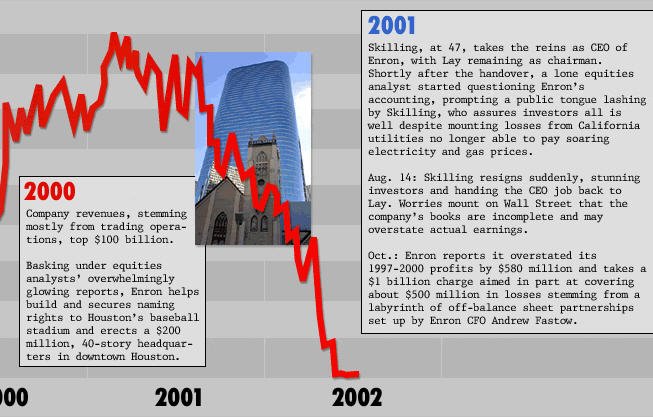
Flashback 07/18/2002Abbey Joseph Cohen is still call ENRON a hold. She has yet to call for a single SELL in a market that all but eroded away. They are the biggest perpetrators.Here is a chart showing the gross incompetence by Abby "the guru" Conehead.

The above image is just a snip from
The Enron Timeline with thanks to the Big Picture Blog.
My recollection is that there was not a single sell recommendation by any major wall street brokerage until after Enron had lost over 95% of its valuation. Now we see Boehner using both Enron and Wordcom as a reason FOR letting the fox guard the henhouse. Oh the Irony.
Please someone tell me how much the brokerage houses have pumped into Boehner's campaign chest. The fact remains that no timely sell signals were isssued on Enron, Worldcom, Kmart, and now GM.
Simple, Straightforward, WrongHere is a snip from the book
Ahead of the Market:
Most of the major brokerage firms, in addition to issuing a recommendation on a stock, also provide a recommendation on the stock's industry. An analyst's recommendation is supposed to boil all his research down into one simple actionable piece of advice, the answer to the question, "Nice ten-page report, but what should I do about the stock?"
Not surprisingly, the recommendation is probably the most widely used piece of information contained in the analysts' research reports simply because it is, at face value, easy to understand and appears to be straight-forward. Do not be fooled. An analyst's recommendation is a wolf in sheep's clothing.
It is simple.
It is straightforward.
And invariably it is wrong.
In fact, if you had bought those stocks that were the most highly recommended by analysts over the two-and-a-half-year period from April 2000 to September 2002, you would have lost a phenomenal 47%.
Worldcom FlashbackLet's check out some
CNN transcripts on Wordcom.
Interview with Scott Woolley
Aired July 8, 2002 - 13:31 ET
PHILLIPS: Now we've got to talk about Jack Grubman, the Salomon Smith Barney analyst. Big player here.
WOOLLEY: Sure. You know, made $20 million a year, back in the height of the telecom boom. Was the most important influential telecom analyst on Wall Street for years and years, very plugged into these companies. Orchestrated and indeed suggested a lot of the major mergers that went through, and in WorldCom's case, turned out very badly. So he's going to take a lot of flak today. There is no question about that. I mean, he really is this poster child for the ethical problems that Wall Street has had over the past four years.
PHILLIPS: Well, he is the one who attended the WorldCom board meetings, he is the one that -- he was calling investors, telling them to sell, correct?
WOOLLEY: Yes. And I mean, he finally got around to issuing a sell recommendation on WorldCom stock a couple days before these accounting problems were issued. I mean -- but he was -- there was no bigger tout on this stock than Jack Grubman. And he was very tied in, and because he was so tied in, people assumed he knew what he was talking about, and that he had a reason for believing in this company. Ultimately it was proven that he didn't.
The SettlementThe May 01, 2003 issue of CFO issued a report entitled
On Closer Examination. Let�s take a look.
As part of a more than $1.4 billion settlement Spitzer brokered with the investment banks over various misdeeds, 10 Wall Street firms, including Merrill Lynch, Credit Suisse First Boston, Smith Barney, and Morgan Stanley, will be required to pay $900 million in "retrospective relief" for investors, $450 million over five years to fund research from independent companies, and another $85 million for educating investors.
The settlement, as well as new rules from the National Association of Securities Dealers, the New York Stock Exchange, and the Securities and Exchange Commission, will also prohibit investment banks from subsidizing their research arms or influencing analysts' pay, and require analysts to disclose relationships with the companies they follow. An additional directive from the SEC will require analysts to certify that their reports reflect their true personal views.
And as long as the one-stop shop remains, analysts will have conflicts, says Haas. "As long as research still comes out of the same house as investment banking, there will be problems," he maintains. He doesn't think the disclosures about bankers' relationships with their research clients will help much, either. According to Haas, the disclosures will eventually look like boilerplate, and people will begin to ignore them.
Hill agrees that reform might not have a huge impact on the system. "You can issue all the 'thou shalt nots' you want, but investment bankers and analysts are going to talk, and [analysts] are still going to feel that they have to play ball," he argues.
A History LessonWhisperNumber is writing about
The Firms and People that Steal Your Money.
"Those who do not learn from the mistakes of history are doomed to repeat them".
A few years back I considered myself an 'Ignorant Individual Investor'. I labeled myself within this group of investors simply because I knew very little about investing or how the Wall Street game was played. I found out during the 'bubble years' that the playing field wasn't level, and that making money turned out to be much more difficult for me than for those 'in the know'. I followed the advice of so-called 'experts', made trades based on 'research' reports, and recommendations. But what I didn't know was that many of these recommendations and reports coming from analysts and professionals were 'bunk'. In many (proven) cases information was intentionally offered to mislead, whether through fraudulent research reports, unfair research, investment banks receiving or not disclosing payments for research, or the engaging in spinning of IPO's. The companies involved in these practices include the following: Citigroup's (NYSE: C) Salomon Smith Barney unit, Merrill Lynch (NYSE: MER), Credit Suisse Group's (NYSE: CSR) Credit Suisse First Boston, Goldman Sachs (NYSE: GS), Morgan Stanley (NYSE: MWD), Bear Stearns (NYSE: BSC), J.P. Morgan Chase (NYSE: JPM), Lehman Brothers (NYSE: LEH), UBS Warburg, and U.S. Bancorp's (NYSE: USB) Piper Jaffray.
These firms hope we stay ignorant and will soon forget the wrong doings they have brought upon us. As for myself, I have neither forgiven nor forgotten. In fact, I'm still quite bitter as the evolution (or better said lack thereof) within Wall Street's research and investment-banking relationships has little changed. It is this bitterness that has helped me become more aware of the field of play. It was not and still is not fair to the individual investor, and my excuse of being ignorant can only be used once. Going forward I know what I'm up against, and I wanted to remind those of you that may be slipping back into your ignorant ways that without real change, you'll have no one to blame but yourself next time. And believe me, there will be (another) next time.
Let's review some of the stories that made quick headlines:
'A top Morgan Stanley stock analyst won't face civil charges in the conflict of interest investigation of analysts and brokerage firms and will be allowed to continue working on Wall Street, a source close to the investigation said Wednesday. Mary Meeker, a leading tech stock analyst, will be criticized in the landmark settlement with Wall Street's top brokerages, but she won't face sanctions like those placed on other star analysts for allegedly misleading investors with biased stock ratings during the street's 1990s "bubble," the source said Wednesday, speaking on condition of anonymity.'
'Merrill Lynch's Henry Blodget is facing regulatory action and Salomon Smith Barney's Jack Grubman has been barred from the securities industry. Frank Quattrone, the former powerful banker in charge of the global technology group in Credit Suisse First Boston, is also being investigated by regulators.'
So what has happened since these very prominent figures have appeared in scandalous news headlines?
Mary Meeker is still at Morgan Stanley, and was recently praised in a Forbes article as "Morgan Stanley's luminary Internet analyst." She was 'allegedly' touring China at the time. And kudos to Forbes for letting bygones be bygones with Mary's 'alleged' wrong doings.
Merrill Lynch hall of famer Henry Blodgett, who privately disparaged stocks he had touted in public, is, (now get this), working for online magazine Slate.com as a reporter to cover the insider trading charges facing Martha Stewart. Slate.com can now join the ranks of CNBC, Reuters etc. for maintaining journalistic integrity. As for the regulatory action against Blodgett (a settlement with no admission of wrong doing was reached with AG Spitzer), well, that would be overlooked on anyone's resume, right?
And in a related Blodgett/Merrill story; in July of this year, Henry Paulson Jr., chief executive of the Goldman Sachs Group, chose former director of research at Merrill Lynch, Andrew Melnick, to run Goldman's research department. What's the relation here? Mr. Melnick was the supervisory analyst in charge of Henry Blodgett at Merrill Lynch. (By the way, Paulson is a Board member of the NYSE). Don't you just get all warm and fuzzy inside knowing that Goldman has taken the high road here and brought in a fresh research perspective?
Jack Grubman has moved on�uh, well�moved over to a new office at least, within Citigroup. (No, really, I couldn't make this stuff up if I tried.) Despite being banned for life from the securities industry for misleading his clients with pumped-up reports on telecommunications companies, Mr. Grubman has an office at a Citigroup bank building (he works at least 15 hours a week at the banking group to help prepare its defense against lawsuits). His $33m severance package maintains that he would have to commit time to the firm's legal team to ensure a payment of $50,000 every three months. The payment is part of a $1.2m cash deal spread over 18 months. The bank is also paying for Mr. Grubman's own legal bills. The severance package included forgiving a $15m loan he was given in 1998; another $12m came from cashed-in share options and restricted stock. Let's hope the 15 hours a week isn't too much for Jack and he spreads it out over five or six days.
Nothing has changed, and nothing will change. If you think otherwise, you're wrong or delusional. How can I be so sure? Easy. Name me one firm that has been brought to court, found guilty and duly punished with executives (remember those guys in charge?) sent off to jail? Better yet, name me more than one individual from the above mentioned firms that has been taken to court, found guilty, assets taken, restitution enforced, and sent to jail? The majority of executives and all the firms have been able to get off neither admitting nor denying wrongdoing, and have ended up paying a pittance of a fine. (By the way, many of the settlements were covered by corporate insurance policies.)
As stated in the opening sentence: "Those who do not learn from the mistakes of history are doomed to repeat them".
A question by MishCan I be blunt?
Hmmm. The Mish telepathic message lines are flooded with responses.
In fact, we are so close to a circuit overload that I have to stop the survey in a new record of 10 seconds flat. It seems the answer is 99 to 1 in favor of Mish being Blunt" so here goes:
Wall Street pimps like Henry Blodgett, Abbey Joseph Cohen, Jack Grubman, Mary Meeker and an endless list of others have proven time and time again they can not be trusted. $1.4 billion in fines spread out over 10 major Wall Street firms is peanuts. With fines that anemic, it is a license to bribe, steal, and cheat. I have no doubt that a big succession of "high fives" went out over that settlement. Wall Street will continue to lie, steal and cheat while smiling and telling you to "have a nice day".
If you want the fox guarding the henhouse then please write your senator or congressman and tell them it is OK with you. If not, please send them an appropriate message. Yes, you have my permission to be blunt.
Mike Shedlock / Mish
http://globaleconomicanalysis.blogspot.com/