Friday, February 3, 2006

Time To Buy Foreclosures?

MSN real estate is suggesting it might be a good time for foreclosures if you're brave.
It might be the best time in years to buy a foreclosure home, which would mean it's perhaps the worst time for thousands of financially strapped U.S. homeowners struggling to hang onto their homes.

Many economic experts are predicting that mortgage delinquencies will rise up to 15% in 2006 among homeowners with higher-cost or "subprime" loans. About 19% of all U.S. home loans are now subprime, in contrast to just 5% 10 years ago, according to the folks at Fitch Ratings, an investment-analysis firm. A lot of those homeowners with adjustable-rate subprime loans will see their loans reset at higher interest rates in the coming months, and that will spell trouble.

The buyers are circling
Other factors expected to contribute to the default phenomenon are already-high consumer debt levels, rising energy costs and the advent of somewhat risky interest-only mortgages. So expect to see a lot of defaults on low-to-mid-level homes in 2006, although your opportunities will vary from market to market, of course.

That said, foreclosure buying is a very competitive game right now, with so many real estate gurus advocating the strategy in books and seminars, and on TV and the Internet. Just do a Web search under "foreclosure opportunities" and you'll see what I mean. Obviously, more and more buyers -- particularly investors -- are looking for an advantage in the game.

While there's not space here to go through all the strategies, buying a "pre-foreclosure" from a defaulting or financially strapped owner might be the best way to go on the consumer end. The county clerk's office keeps lists of such pre-foreclosures. Seek out titles where a "lis pendens" notice has been filed by the lender.

Be tenacious � and cautious
Before contacting and engaging in negotiations with the owners of these properties, make sure you are pre-qualified for a loan. You'll probably want to enlist a buyer's agent to make sure your best interests are represented and that you make the right offer -- which would ideally be at a below-market price.

Finding an agent with foreclosure experience would also be a plus.

The foreclosure-property auctions that you see advertised are usually the realm of more heavily bankrolled professional investors who stand ready to pay cash for a property.

If you are brave and well capitalized, you might try your hand at it. You might want to attend one or two for observation before acting. Whichever approach you try, don't give up if your first few efforts don't pan out. Eventually, your tenacity will pay off in substantial savings. Good luck and happy hunting.
Now is the best time in years to buy foreclosures?
Let's be serious. Wouldn't it have been better to buy a foreclosure in California or Florida 4 years ago and sold it last year? How can this possibly be the best time when "so many real estate gurus are advocating the strategy in books and seminars, and on TV and the Internet".

This sounds more like a top to me. Perhaps there is a bargain or two out there, especially if one has skills to do any fixing up that needs to be done, but when the "buyers are circling" and most of them are rookies that have for the most part only experienced an up market, I think the advice is like telling someone to go ahead and buy JDSU or some other stock on the first pullback in 2000. Yep, if you were quick enough many stocks bounced, even JDSU. OK you could have bought the pullback from 100 to 75 and got out at 100. But if you held JDSU is currently at $3. Real estate is a lot less liquid that JDSU was at the time.

Foreclosures Climb
The Star Telegram is reporting Home foreclosures continue to climb.
The number of homes slated for foreclosure continues to rise in Tarrant County, with 1,101 headed to auction next month. That is a 17-year high, according to Foreclosure Listing Service.

That total is up 27.6 percent from a year ago. The total of 3,583 homes facing foreclosure in Tarrant, Dallas, Denton and Collin counties is the highest since 1989, according to the Addison company.

Consumer advocates and foreclosure analysts said several factors are driving up foreclosures. Among them are rising payments on adjustable-rate mortgages, high energy costs, job losses and higher required minimum credit-card payments.

"Any one of them would be serious," said George Roddy, president of the Foreclosure Listing Service. He cited last year's changes to the federal bankruptcy law, which make filing for protection more difficult, as another possible factor. Before the change, he said, Texas homeowners often turned to bankruptcy protection to keep their homes out of foreclosure.

The number of foreclosures started edging upward a few years ago after the layoffs in the telecom and airline industries. But foreclosures have continued to rise even as the economy has improved.

"We're moving from high levels to extremely high levels," Roddy said. "There's no other reason they would jump other than the reasons I mentioned, and those reasons aren't going to change."

Analysts said rising interest rates, particularly on adjustable-rate mortgages, have forced some homeowners to give up their houses. The average interest rate hit a two-year high of 6.37 percent in November, according to Freddie Mac.

A typical ARM can increase the interest rate on a loan by 2 percentage points at once, driving the payment up by hundreds of dollars.

"The amount that [the payment] goes up over time is generally more than somebody's salary would go up," said Dara Boswell, manager of the call center for the Consumer Credit Counseling Services office in Fort Worth.

Boswell also said that many new-home buyers are not getting their taxes escrowed -- intentionally or not. Others are surprised when they get their tax bills in the year after the purchase, because their initial tax assessments included only the land, not the house, she said.

The homes will be auctioned on the Tarrant County Courthouse steps Feb. 7.
Tarrant County Auction
If someone is in the area I would be curious as to how frantic the buying is. I suspect many people will be overpaying at that auction relative to what they could get if they just went out and bought a house. How many shills will be there representing lenders that want to fetch a certain price just to get their money back? Many times you can not even inspect the homes but I do not know if that is the case for this auction or not. Buy a house with a leaking basement or roof and you have a big problem.

Housing Divide
The Dallas News is reporting a "Housing Divide" with smaller mortgages falling to foreclosures as high-end sales climb.
In a healthy local housing market, a sign of trouble has appeared: More people are losing their homes to foreclosure than at any time since the Texas real estate bust of the 1980s.

The causes run from bad luck to bad financial decisions: job loss, divorce, a health crisis, skyrocketing energy bills, out-of-control credit card debt or a mortgage payment that turned out to be unaffordable.

But there also seems to be a sharpening contrast between real estate markets at either end of the economic ladder.

As residential foreclosures jumped 30 percent from a year ago in North Texas, the average mortgage on foreclosed houses fell to $129,000, compared with almost $146,000 a year ago.

Meanwhile, home sales set records last year, with a strong 20 percent increase in sales of homes priced over $400,000.

But there was a 4 percent decrease in sales of homes priced below $110,000.

"What we're seeing develop in the marketplace is the haves and the have-nots," said Craig Jarrell, who heads up the Dallas operations of Pulaski Mortgage Co.

"Either you've got money and you've got a job and you're buying a new house and you're rocking along," he said. "Or you're underwater and can't buy a new house, and can't afford the one you're in and you're going into foreclosure."

That's not the whole picture, of course. The foreclosure hammer also recently fell on an Addison home valued at $1.5 million, a North Dallas house valued at nearly $870,000 and a Coppell property worth about $430,000.

But Connie Zetterlund, a Coldwell Banker Residential agent who specializes in foreclosed property sales, says she's noticed increasing signs of trouble at lower-priced properties.

"The price ranges are a little lower than last year," she said. "There are a ton of foreclosures out there right now."

That's not the only trend. Ms. Zetterlund has also noticed more trouble among newer mortgages, the ones acquired after the economic downturn earlier this decade.

"I'm seeing a lot of properties bought in 2004 and already going to foreclosure," she said.

In the last foreclosure boom, lenders dumped houses and it wasn't uncommon to see property values fall by 30 or 40 percent in a neighborhood, Mr. Roddy said.

Now, some real estate investors are looking at the Dallas-Fort Worth area as a place where bargains can be had for lender sales. So far, however, lenders are seeking top dollar for such homes, even if that means keeping them on the market longer, realtors say.

"We certainly haven't seen the value loss like we had in the 1980s," Mr. Roddy said. "But if the foreclosure numbers hold up like we've seen for February, it could be pretty scary."
Problems Facing Dip Buyers
Here is one problem facing the first wave of "dip buyers": Real estate investors are looking at the Dallas-Fort Worth area as a place where bargains can be had for lender sales. So far, however, lenders are seeking top dollar for such homes, even if that means keeping them on the market longer, realtors say.

Dippers dip, because that's what they were trained to do. Just as with JDSU, once the trend changes it is very tough to change one's perspective.

Another reason why this is not the dip to buy is the massive inventory of homes and the massive numbers of homes big homebuilders need to get rid of.

A 15% dip might seem attractive, until Poof - 25% Vanishes Overnight. I guess in the scenario described, one would only be 10% underwater plus commissions if one had to sell, assuming of course there was a bid.

Another problem for dip buyers is our economy seems like it is headed for a recession.
The FED seems hell bent on breaking something too. Let's see how many more hikes it takes before the FED breaks the bubble in junk bonds and credit lending. If it takes 2-3 more, what will that do to housing?

Sheriff�s Sales Rise
NewsZap is reporting a sixfold increase in sheriff�s sales.
When Kent County [Delaware] Sheriff James A. Higdon took office 11 years ago, the usual number of sheriff sales was five or six a month.

"And now it�s not unusual to have over 30," he said.
Homes are sold in sheriff sales for either tax or mortgage foreclosure.

"Today, Americans live paycheck to paycheck," said Dover real estate agent Rocke Gaston. "Look at our credit card debt, it�s atrocious. I foresee a day soon where these mortgages are given out and they�re going to regret it."

Buyer beware
Buying a property in a sheriff�s sale requires homework and a strong stomach.

"When you buy a house in a sheriff sale, it�s a risk," said Mr. Gaston, a frequent auction buyer.

It�s recommended that potential buyers research the property for liens and to make sure taxes are current. They might also drive past a property or peek inside a window, but they won�t be able to go inside the house.

The rest, the sheriff said, is at the buyer�s own risk.
"We can�t guarantee anything," he said.

A year ago, Mr. Gaston said he�d found good bargains on houses. But lately, they�ve sold for close to retail prices.

"It�s a seller�s market," he said. "Were coming to the end of it."
Foreclosures are not just a US phenomenon either. Forbes is reporting
House repossession actions surge in England & Wales in Q4 to highest in 13 yrs.
The number of actions presented by banks and building societies to repossess properties surged in the fourth quarter of 2005 to their highest level since the UK last emerged from a recession in 1993, government figures showed today.

The Department of Constitutional Affairs revealed that there were 31,018 mortgage possession actions entered during the quarter, and a total of 18,784 orders were made.

The number of actions entered were 50 pct higher than the previous year, and at their highest level since the third quarter of 1993 when the UK housing market was just emerging from one of its deepest crashes ever.

Elsewhere today, the Department of Trade and Industry revealed that the number of personal bankruptcies in England and Wales during the fourth quarter were 20,461. This was a 15 pct increase on the previous quarter and a 57.1 pct rise on a year-on-year basis.

The DTI also said the number of company liquidations during the quarter fell 5.5 pct on a quarterly basis to 3,187. However, that was 8.5 pct higher than a year ago.

'The rise in bad debt, alongside the recent slowdown in consumer credit, suggests that households are starting to feel the pressure of their rapid build-up in recent years,' said Vicky Redwood, UK economist at Capital Economics.
Home $weet Home

Real estate has now clearly peaked, worldwide, I might add. Back on June 7th, 2005 I put in a top call with help from Time Magazine. That top call was based on this:
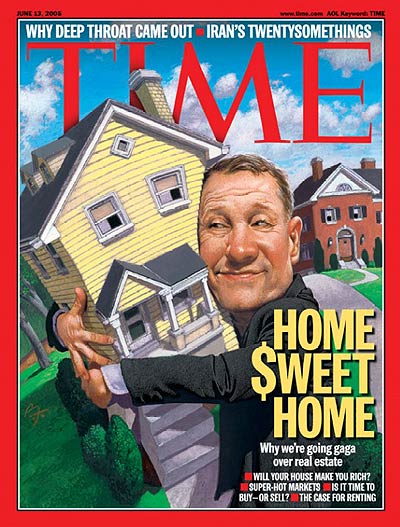


Time Magazine went gaga over real estate on the June 12th issue, right at the very peak of the bubble. Congratulations must go out to Time Magazine for that fine achievement.

Now just 6 months later, with some areas still bubbly, MSN real estate is suggesting it is time to buy the dip in foreclosures. I have a better idea: wait until no one else wants them.

Mike Shedlock / Mish
http://globaleconomicanalysis.blogspot.com/

Thursday, February 2, 2006

political requirements of bridge met

Construction Equipment Guide seems very pleased to report
Detroit Bridge Ready for Some Football.
If you�re headed to Super Bowl XL in Detroit, MI, this February, you might be pleasantly surprised � and impressed � by Detroit�s newly completed $14-million Gateway Bridge spanning Telegraph Road along I-94 in Taylor.

The graceful twin arches join the giant Uniroyal Tire in welcoming visitors on the drive into downtown from the new Detroit Metropolitan Airport.

The Detroit Regional Gateway Advisory Council (DRGAC) � a collaboration between state and local governments and private sector investors formed in 2002 � expect the bridge to enhance the image of metro Detroit, improve the regional transportation system and provide impetus for future regional partnerships.

�These I-94 improvements will go a long way to enhance the first impressions of visitors and more accurately reflect the quality of life enjoyed by those of us who live in the Detroit region,� reported Paul Hillegonds, president of Detroit Renaissance.

DRGAC raised $1.5 million from private sector donations and grant money through Detroit Renaissance, and received a commitment of more than $7 million from the state of Michigan, plus $500,000 from the city of Taylor. Wayne County and the city of Detroit pledged a combined total of $250,000 per year to maintain the improvements.

"There was a lot of negative feedback initially,� confirmed Kim Avery of MDOT. �But the bridge really signifies cost savings. There were under-clearance issues because the beams and span are narrower than conventional bridges. Otherwise, we would have had to lower the road. That would have been more expensive with all the roadwork involved. This bridge has a thinner deck and beams."

Avery noted that private sector funds made up much of the $1.5 million price difference, and that the governor favored the plan. "He liked the savings features, and the fact that it met political requirements."

Like many other states facing budget crunches, Michigan has "put the brakes on expansion projects," she explained, "but this is considered preservation and rehabilitation."

The Gateway Bridge falls under Michigan�s "preserve first" plan.
Preserve First?
Here is a picture of what $14 million of preservation buys:


Now it's question time:
  1. Is that really an image enhancement?
  2. Even if so, is the enhancement worth $14 million?
  3. Exactly what is being "preserved" by building this bridge?
  4. Does this seem like "putting the brakes on expansion projects"?
  5. Doesn't Detroit have far more pressing problems than building a bridge shaped like a football?
  6. Doesn't the annual maintenance budget of $250,000 strike anyone as excessive?
  7. Exactly what "political requirements" were met by this design?
  8. Last but certainly not least, why should bridges have political requirements in the first place?
Mike Shedlock / Mish
http://globaleconomicanalysis.blogspot.com/

Inflation: What the heck is it?

Inflation has at least 8 distinctly different definitions that I can readily find, and probably a whole lot more that I have not yet found.

Commonly Used Definitions
  1. Decline in purchasing power of the currency held
  2. Rising prices in general (essentially the same as #1 although some might disagree)
  3. Rising consumer prices (CPI)
  4. Rising producer prices (PPI)
  5. Rising prices due to expansion of money supply
  6. Rising prices due to expansion of money supply and credit
  7. Expansion of money supply
  8. Expansion of money supply and credit
Four of those definitions refer to money supply. That brings up another issue. When one refers to "money supply" are they talking about M1, M2, MZM, Money AMS (Austrian Money Supply), or simply the amount of money they have in their bank account or wallet at the time of the conversation? Definitions 5 and 6 refer to "rising prices" yet fail to distinguish between consumer prices, producer prices, or simply prices in general. It seems we could easily add a lot more definitions.

Furthermore, some people make no distinction between money and credit but others do as noted by choices 5 thru 8. Still others insist than in the fiat world we are in, the web is so tangled between money and credit that this mess is not even worth bothering to figure out. Those folks simply hold gold and wait for "The Crash".

The thing is, it is simply impossible to argue about inflation (or anything else) unless one can agree on a definition. Like it or not, we live in a fiat world. Therefore we must attempt to have sound definitions that best describe the fiat world we are in.

A Dictionary Definition

Dictionary.com defines inflation as: A persistent increase in the level of consumer prices or a persistent decline in the purchasing power of money, caused by an increase in available currency and credit beyond the proportion of available goods and services.

One might commend dictionary.com for making the distinction between money and credit, but others might take exception to "consumer prices" vs. "prices in general", and still others might argue endlessly about what "purchasing power" means. The real problem with the definition however, is that it puts the cart before the horse.

The Cart before the Horse

The problem with definitions that have a "because of" clause is that it impossible to know exactly why prices are rising or falling. Should rising oil prices due to peak oil, geopolitical concerns, hurricanes, or other supply disruptions really constitute inflation? More to the point: Is there any possible way to decide what % of the increase in the price of oil (or anything else) was "caused by an increase in available currency and credit beyond the proportion of available goods and services"?

The answer to that latter question is easy: of course not. Furthermore, the natural state of affairs is decreasing prices because of increasing productivity (more goods produced by less labor) thereby causing a drop in prices over time. One farmer today produces as much wheat or corn as did 20 or even 100 farmers not that long ago. Unions strive to protect jobs even though one worker today produces more cars than several workers a decade ago.

Dictionary.com thus proposes a definition of inflation that simply can not be measured. The problem is the "because of" clause that puts the cart before the horse.

Is Price all that Matters?

Of course those in the "price is all that matters" camp have no such problems. To them, prices of a basket of goods and services rose, therefore inflation rose. A big problem for those in this camp is that rising asset prices (such as stock market equities) are not properly accounted for in any known basket of goods and services.

Some might argue that that problem can be solved by including stock market prices in the basket of goods and services. Unfortunately that further compounds the problem by orders of magnitude. How does one decide which stocks to include in the basket as well as the relative weighting of those stocks? Furthermore, is it really valid to call genuine improvements in business conditions "inflation"?

Even without the problem of equity assets, there is a huge problem of selecting a basket of goods and services that works for both consumers and producers. Not only is it impossible to accurately pick a representative basket of goods an services that properly measures "purchasing power", it is also impossible to make accurate quality judgments about the prices of goods in that basket.

For example: double pane insulated argon gas filled windows are now common. How does one measure the price of those windows with windows thirty years ago when such a thing did not even exist? How does one accurately measure the relative values of such windows vs. the windows of yesteryear? It simply can not be done! Practically speaking, the price drop is 100% because one could not get those windows at any price if you go back far enough.

How long ago was it that PCs, Gore-Tex, and Teflon did not exist? How does one accurately account for that? Backward price measurement comparisons are simply hopeless because of a continuous array of new product and service offerings. Some even look at such quality improvements to make a claim that the CPI is actually overstated! The ranges for overstatement that I have seen are generally 1-2% and understatement by as much as 6-7%. Can a definition of inflation that includes enormously subjective measures possibly be of use to anyone?

Is a basket that relies solely on producer prices (PPI) the answer? If so how does one properly account for rising consumer prices but not producer prices and vice versa? Obviously this line of reasoning is hopeless.

The problem of accounting for stock market fluctuations is even worse for those in the "price increases caused by an increase in available currency and credit" camp because they have to decide if stock market prices are rising or falling because of general business conditions or because of expansion of money supply, risk taking, speculation, or time preferences.

A Look Back at the New Economy

Let's take a step back from all this madness and consider the decade of the 1990's. In the mid to late 1990's money supply rose dramatically by any commonly used measure yet the folks in the "price is all that matters" and "purchasing power" camps were not alarmed because the price of oil and gold and copper and computers were falling as Greenspan became a cheerleader for the "New Economy". Can a definition of inflation that ignores such problems possibly be right?

The fatal flaw made by Greenspan and the "price is all that matters" camp is that productivity improvements led by an internet revolution, along with global wage arbitrage and outsourcing to China and India, lowered costs on manufactured goods and kept the lid on wage increases in the manufacturing sector. Those factors all helped mask rampant inflation in money supply. The Greenspan FED further compounded the problem by injecting massive amounts of money to fight a mythical Y2K dragon that simply did not exist. Those monetary injections helped fuel a massive bubble in the stock market in 2000.

Everyone in the "price is all that matters/purchasing power" camp either has to ignore equity distortions or account for them by adding equity prices to the basket of goods and services. Either way is problematic.

The Role of Government

Those in the "because of" camp also need to take account of the fact that rising prices in a basket of goods and services as well as rising equity prices often happen because of "government imposed solutions to nonexistent problems".

One can even logically argue that government itself is the primary cause of rising prices. Look no further than Y2K, a Medicaid Bill that legislates against mass purchases of drugs, congressional action that impose tariffs on crops and lumber, congressional actions that prevents drug imports from Canada, builds bridges to nowhere in Alaska, and other such nonsense.

There are now more than 200 governmental bills designed to make housing affordable. The worst of the lot were bills authorizing creation of the GSEs (Fannie Mae and Freddie Mac). Lenders eventually figured out how easy it is to dump the riskiest loans onto those quasi government agencies. Credit standards then went downhill and home prices sky rocketed.

As reported in the Washington Post article FHA Alternatives To Subprime Loans Alphonso Jackson, Housing and Urban Development Secretary actually went so far as to send this message to private sub-prime lenders: "We need to reach out to African-American, Hispanic and other first-time buyers with better loan concepts, more flexible guidelines and quicker service. I am absolutely emphatic about winning back our share of the market that has slipped away to subprime lenders."

A government desire to win back market share from private lenders is most assuredly pure insanity. Indeed, promotion of the ownership society itself is at the very heart of this mess. Supposedly the government wants "affordable housing" yet it puts into practice anti-free market policies that absolutely ensure the opposite.

Let's briefly discuss Medicare/Medicaid. Government policies prohibit negotiation of bulk discounts. Those policies also prohibit imports from Canada and other nations willing to provide drugs at a cheaper cost. The most recent boondoggle is a process whereby recipients can only change providers once a year while providers can add or drop coverage with a mere 60 days notice. Someone signing up for benefits specifically because a needed drug was covered may find out after 60 days they have to eat the entire cost. What kind of sense does any of that make?

Somehow entitlement programs always have enormous cost overruns. The Medicare/Medicaid bill is no exception. Before the bill was even passed, its costs were known to be understated by at least $139 billion dollars. The Washington Post article White House Had Role In Withholding Medicare Data notes that Richard S. Foster, the government's chief analyst of Medicare costs was threatened with firing if he disclosed the true costs of the bill to Congress. The bill passed by an extremely slim margin. Had the true costs been disclosed it is doubtful the bill would have passed.

If you are looking for a source of inflation, there is no doubt that Greenspan, the FED, and government policies are all a huge part of the problem. What is interesting is that Greenspan is now finally starting to make sense for the first time in his entire career with his recent warnings about Fannie Mae, government spending, and trade deficits. For 18 years everyone listened to "The Maestro" even though most of what he said was totally unintelligible. Now the ultimate irony is that no one is paying attention just as he is finally starting to make some sense.

We will leave this matter for another time except to point out the following: The government and the FED are both always fighting some sort of mythical dragon. That is a huge problem over time.

A Use for the CPI

Let's now return to a question I asked earlier: Can a definition of inflation that includes enormously subjective measures such as the CPI possibly be of use to anyone? Actually it can, but not to any private citizen's benefit. The basket of goods and services as well as subjective measures of quality improvements can indeed be used by the government to underpay holders of inflation protected securities like TIPS, as well as understate cost of living adjustments to social security recipients.

How many believe the government's basket of goods and services is overweight computers and appliances and underweight heating bills, medical expenses, gasoline, insurance, and housing? Even if one believes the government was honest about the makeup of the basket, is the government biased about subjective measures of quality improvement of items in that basket? The problem of baskets and weightings is simply impossible to solve. The cynical will propose it is impossible to solve on purpose.

Money vs. Credit

Because of cart before the horse problems, basket selection problems, PPI vs. CPI problems, asset price problems, and government manipulation problems, we can easily discard the first 6 widely used definitions of inflation. That leaves us with a choice between the following:
  1. A net expansion of money supply
  2. A net expansion of money supply and credit
Given the current government policies that allow tremendous leverage via the fractional reserve lending, the most logical conclusion is that it is indeed necessary to distinguish between money and credit.

Fortunately the work in this area has already been accomplished by Austrian economist Frank Shostak. In The Mystery of the Money Supply Definition Shostak makes note of the difference between money supply and credit, while making a solid case that Money Supply (elsewhere called Austrian Money Supply or Money AMS) is Cash+demand deposits with commercial banks and thrift institutions+government deposits with banks and the central bank. The difference between Money AMS and other published "money supply" figures such as M1, M2, M3, or MZM is therefore either credit, over-counting, or pure nonsense.

Before making a final decision between the two remaining definitions let's first consider a real world example: Japan 1982-2004. Some argue that Japan never went through deflation. One basis for that argument is that "money supply" as measured by M1 never contracted over a sustained period. The other argument is that prices as measured by the CPI never fell much. Once again we have a flawed argument about consumer prices and a flawed argument that only looks at money and not credit.

Although Japan was rapidly printing money, a destruction of credit was happening at a far greater pace. There was an overall contraction of credit in Japan for close to 5 consecutive years. Property values plunged for 18 consecutive years. The stock market plunged from 40,000 to 7,000. Cash was hoarded and the velocity of money collapsed. Those are classic symptoms of deflation that a proper definition incorporating both money supply and credit would readily catch. Those looking at consumer prices or monetary injections by the bank of Japan were far off the mark.

Frank Shostak nicely describes the end of such economic booms in Making Sense of Money Supply Data:

As prices of financial assets begin to rise, in order to keep their growth momentum intact the money supply rate of growth must expand. Any slowdown in the money supply rate of growth will slow the growth momentum of financial assets' prices.

Once the rate of growth slows down false activities encounter trouble. Since the diversion of real resources toward these activities slows down, a fall in the money rate of growth strangles them. It follows then that rising growth momentum of money leads to an expansion in nonwealth generating activities (also known as an economic "boom") while a fall in growth momentum undermines false activities and results in an economic bust.


Note that it was a continued collapse in credit as opposed to a collapse in government monetary printing that eventually sealed the fate in Japan. The lesson to be learned from Japan is that once the ability and/or desire of consumers and corporations to take on more debt is reached, the party is over barring and out and out hyperinflationary expansion of money. For a discussion of Ben Bernanke's hyperinflationary "helicopter drop" solution to deflation, please see Robert Blumen's article Bernanke: Foreign Savings Glut Harms the US.

In practice, a helicopter drop of money would bail out consumers at the expense of the FED. Furthermore such actions would eventually destroy the FED's own power and wealth. Logic would therefore dictate that the helicopter drop threat would not be carried out in actual practice. No doubt there will be further endless debate on this subject, one way or another, until the final collapse is at hand.

Conclusions

The logical outcome of the above discussion is that a proper definition of inflation or deflation must be built on the foundation of a sound definition of money supply that distinguishes between money itself and credit. The definition should also ensure that the horse and the cart are in their proper places.

With the above in mind:
  1. Inflation is best described as a net expansion of money supply and credit.
  2. Deflation is logically the opposite, a net contraction of money supply and credit.
  3. Government mandated solutions to problems best left to the free market is the root cause of money supply expansion.
  4. With no enforcement mechanism such as a gold standard to keep things honest, and with no desire to raise taxes, governments simply approve programs with no way to fund them. The FED has been all too willing to play along by printing the money needed for those government programs. To make matters worse, the fractional reserve lending policies of the FED allows an even greater expansion of credit on top of the money printed. Eventually those actions result in a crack-up-boom and debasement of currency.
  5. Changes in "Purchasing power" required to buy a basket of goods and services can not be accurately measured because of the need to continuously add new products to the basket, because the measurement of quality improvements on existing products is too subjective, and because it is impossible to pick a representative and properly weighted basket of goods, services, and assets in the first place. Furthermore, such measurements are highly prone to governmental manipulation at private citizen expense. Endless bickering over the CPI numbers every month should be proof enough of these allegations.
  6. Measurement of equity price fluctuations poses a particularly difficult problem for those bound and determined to put the cart before the horse as well as those that think such assets belong in any sort of basket.
  7. Price targeting by the FED is doomed to failure because a representative basket of goods and services can not be created, because prices can not properly be measured, and because price targeting puts the cart before the horse.
  8. Expansion of money supply (typically to accommodate unfunded government spending) and expansion of credit (via GSEs, fractional reserve lending, and other unsecured debt issuance) are two of the biggest problems. Targeting the outcome (prices) can not possibly be the solution.
  9. Ludwig von Mises describes the endgame brought on by reckless expansion of credit: "There is no means of avoiding the final collapse of a boom brought about by credit (debt) expansion. The alternative is only whether the crisis should come sooner as the result of a voluntary abandonment of further credit (debt) expansion, or later as a final and total catastrophe of the currency system involved."
  10. The FED should have been listening to Mises all along. Instead they have put their faith in "productivity miracles", "new paradigms", and their own hubris. Those actions have accomplished nothing other than delay the eventual day of reckoning.
Mike Shedlock / Mish
http://globaleconomicanalysis.blogspot.com/

The In-between

I've always had a thing for interstitial spaces, those leftover gaps between inside and outside. Some architects try to exploit the tension that exists in these spaces, though many times these gaps are leftover spaces that are off limits or difficult to get at. A case in point is the space between the inner and outer shell of Brunelleschi's dome for the Duomo in Florence. This narrow and curving space is an awkward and apparently unwelcome path to the cupola and its breathtaking view, though definitely worth the claustrophobic feelings along the way.

In an exhibition currently at the Chicago Cultural Center (until March 19) and a concurrent one at Oak Park's Unity Temple, Dutch photographer Jan Theun van Rees scopes these in-between spaces, giving people a glimpse into places typically beyond their reach.

Missing image - vanrees1.jpg

Above shows one of his photos of Frank Lloyd Wright's Unity Temple (the area above the main space's stained glass ceiling), taken over four one-week visits. In a Sun-Times article, the photographer is quoted as saying, "At first I assumed there were no hidden spaces in a building like that, because it was designed so economically, but I was surprised."

Missing image - vanrees2.jpg

For his shots of the Cultural Center, he squeezed himself into the space between the Tiffany glass domes and the outer roof with his 40-pound camera. Similar in vein to the Duomo's double-shell, these bottom-lit spaces actually make one want to find a way to get into these gaps.

It's Groundhod Day!

Missing image - groundhogday.jpg

Some links for your enjoyment on this day:
- My review of Ryan Gilbey's book on the Bill Murray film.
- The Internet Movie Database's page on the film.
- Groundhog Day The Movie, Buddhism and Me, a page with lots of text and links on the film's religious impact, by Paul Schindler.
- The Official Site of the Punxsutawney Groundhog Club.

Wednesday, February 1, 2006

Jobs and wages during the recovery

This post takes a look at the effectiveness of the Bush administration tax cuts, jobs, wages, housing, and the "Bernanke Handoff".

The charts below are thanks to the Economic Policy Institute.
Here goes:

Failure of the Bush tax cuts


Changes in tax law since 2001 reduced federal government revenue by $870 billion through September 2005. Supporters of these tax cuts have touted them as great contributors to growth in jobs and pay. But, in reality, private-sector job growth since 2001 has been disappointing, and a closer look at the new jobs created shows that federal spending�not tax cuts�are responsible for the jobs created in the past five years.

If tax cuts have created jobs at all since 2001, it will have happened in the private sector. Assuming that job growth in 2006 matches the Bush Administration's projections, the economy will have added about 2.0 million jobs to the private sector from FY2001 through FY2006. But how many of these two million jobs actually can be attributed to tax cuts and how many to increased government spending�particularly increased defense spending�in this period?


Based on Defense Department estimates of the number of private-sector jobs created by its own spending, we project that additional defense spending will account for a 1.495 million gain in private sector jobs between FY2001 and FY2006. Furthermore, increases in non-defense discretionary spending since 2001 will have added yet another 1.325 million jobs in the private sector, for a total of 2.82 million jobs created by increased government spending. Increased mandatory government spending�which is not even included in these estimates or the accompanying chart�would account for even more job creation. The mere fact that the projected job growth resulting from increased defense and other government spending exceeds the actual number of jobs projected to be added to the economy through 2006 clearly indicates that the tax cuts hardly seem plausible as the engine of the modest job growth in the economy since 2001.

Why people are so dissatisfied with today's economy


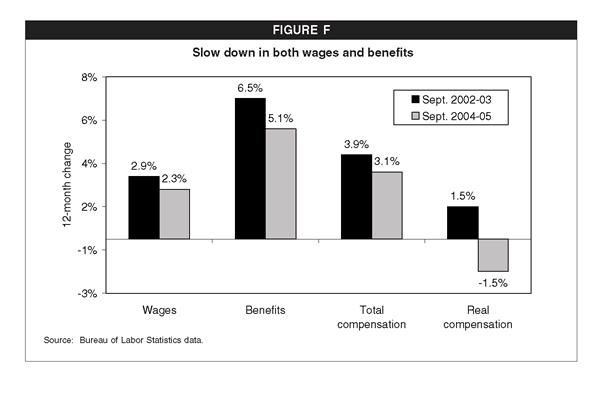
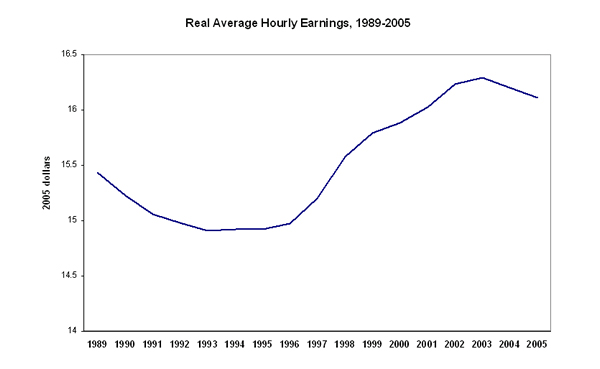
Real wages were down for the second full year in 2005
Adjusted for inflation, hourly and weekly earnings fell for most workers in 2005


Real earnings growth flat to negative in 2003
Very negative since then


Thanks again to the Economic Policy Institute.

The question is: where to from here?
Treasury secretary Snow and Bush both point to a continued recovery, but the above data suggest that is only possible if government spending picks up. Consumers are showing signs of severe stress with each and every hike. Some think that capex spending will save the day but as discussed in Thoughts on the Handover Fallacy, that seems highly unlikely.

With negative savings and cash-out refis withering on the vine, only the stock market, rising wages, or a renewed housing bubble can save consumer spending. The latter two choices seem unlikely. Global wage arbitrage is still putting severe pressure on wages and benefits.

Housing itself is like a supertanker. Supertankers are very slow to change direction, and once they do, much harder still to immediately turn back around. The housing supertanker has now turned. The top is in.

That leaves the stock market. Unfortunately for stock market hopefuls there are a multitude of problems:
  • Studies suggest consumers are more likely to spend housing gains than stock market gains.
  • A flat to negative yield curve is not conducive to corporate earnings growth.
  • This recovery is actually quite long by historical standards.
  • The second year election cycle suggests a slowdown.
  • Global wage arbitrage and outsourcing still seem to be going strong.
  • A cutback in Iraq war spending is now underway.
  • Energy and medical expenses continue to cut into consumer discretionary consumer spending.
  • 1/3 of the houses sold in 2004 were second home or for investment. That is not sustainable.
  • Housing fire sales such as housing fire sales suggest declining consumer speculation. Those are on top of Poof - 25% Underwater Overnight fire sales.
Just as the stock market went irrationally higher in Spring of 2000, it could be doing the same once again. The blowoff stages of credit expansion are upon us. Once credit contraction starts the FED will be powerless to stop it. Bernanke's test is coming up soon. He gets to face declining wages, falling home prices, rising gold and oil prices, no letup in outsourcing, but increased corporate speculation via leveraged buyouts, mergers, spinoffs, and buybacks. Greenspan successfully passed the baton. What will Bernanke do with it?

Mike Shedlock / Mish
http://globaleconomicanalysis.blogspot.com/

Kresge Peek

The Kresge Foundation, an independent, private foundation created in 1924 by Sebastian S. Kresge "to promote the well-being of mankind" is located in Troy, Michigan, a suburb of Detroit that's closer - geographically and economically - to Bloomfield Hills, home to Cranbrook.

Missing image - kresge1sm.jpg

The Foundation's new home is designed by Chicago's Valerio DeWalt Train and reuses their existing farmhouse and barn while adding 17,000 square feet of office space.

Missing image - kresge2sm.jpg

According to VDT's project description (PDF link), the project has been designed to achieve a LEED platinum rating, the highest in the U.S. Green Building Council's rating system for sustainability.

Missing image - kresge3sm.jpgMissing image - kresge4sm.jpg

Apparent from these images are the use of rooftop landscaping and natural daylighting, though the project also includes a ground water heat exchange.

Missing image - kresge5sm.jpg

My friend Dan worked on this project (the Foundation moved in last week) and it appears to be a fitting extension of his other sustainable pursuits predating this project. But of course credit should also be given to Kresge as well as the folks at VDT, especially since the Foundation has instituted a Green Building Initiative, "to encourage environmentally sustainable nonprofit organizations." It's great to see somebody practice what they preach.

Many thanks to Bill Kissinger for the images (by Joe Valerio - click for larger views).
 
Copyright 2010 Camera Dashboard. All rights reserved.
Themes by Ex Templates Blogger Templates l Home Recordings l Studio Rekaman