Friday, January 20, 2006

Poof - 25% Underwater Overnight

How would you like to wake up in a house that declined 25% in value overnight?
If you are a proud Centex owner at "Martins Crossing" in Florida, it just happened to you.

SAVE $105,000 - Centex Close Out - NOW $294,000 - NEW Single Family Home in Martins Crossing - 4 Bedroom, 2 Bathroom, 2 Car Garage - 1,695 sf.
BEST DEAL OF THE YEAR!

Let's see.
Save $105,000
Now $294,000
=============
PP $399,000
$105,000/$399,000 = 26.32%

Poof.
$105,000 just went up in smoke.
That ENTIRE subdivision just took a $100,000+ hit.

Wait a second.
This can't happen, can it?
They are not making land in Florida anymore are they?
People want to move to Florida right?
Did it matter?

This exact scenario is going to play out in bubble area, after bubble area, after bubble area.
The party has just started.

Mike Shedlock / Mish
http://globaleconomicanalysis.blogspot.com/

Links-a-lot

As you can see from my paltry posts lately, this week has been busy. To partially make up for this, I've provided some links below that will hopefully be of interest and are worth a look and/or a read.
:: A bookstore organized by color (via)
:: Hidden Landmarks of Manhattan
:: Defying Death (on Arakawa)
:: Scandal Becomes Her
:: Green Yale Degree
:: Cardinals Stadium (by Peter Eisenman, below)

Missing image - cardinals.jpg

:: Two films to see
:: Map of World Heritage Properties
:: The Bird Man
:: Renzo Piano Interview
:: Now you see it...
As always, many links via.

Thursday, January 19, 2006

312 Million for This?

Toll Brothers, Meritage Homes and Simon Property Group Joint Venture announce the purchase of a 5,485-acre land parcel in Phoenix's Northwest Valley for $312 Million.
It is the largest real estate transaction in Arizona history.
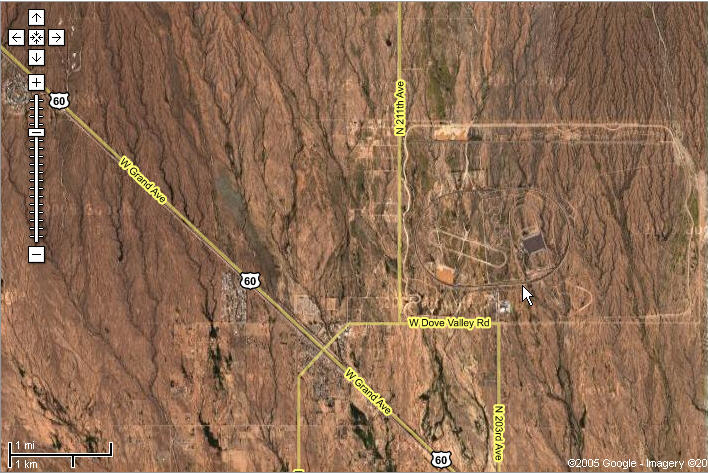
The Maricopa County property, which DaimlerChrysler currently utilizes as a vehicle endurance testing and development facility, is bound by 183rd Avenue on the east, 211th Avenue on the west, Dove Valley on the south and Joy Ranch Road on the north. DaimlerChrysler will continue to lease the property for the next few years, in order to plan and accommodate for the orderly transition of its testing operations.

Toll Brothers and Meritage Homes each plan to build a significant number of homes on the site. Simon Property Group, Inc. has the option to purchase a substantial portion of the commercial property. Other parcels may be sold to third parties. Initial plans call for a mixed-use master planned community, which will include approximately 4,840 acres of single-family homes and attached homes. Approximately 645 acres of commercial and retail development will include schools, community amenities and open space. Initial homes sales are tentatively scheduled to begin in 2009. According to the approved General Plan, the site allows between 15,000 to 31,000 homes.

Robert I. Toll, chairman and chief executive officer of Toll Brothers, Inc., stated: "We are thrilled to have been chosen by DaimlerChrysler and to have teamed up with two excellent partners to develop this fabulous piece of real estate. The northwest area of Phoenix has experienced unprecedented popularity and this particular parcel is a highly coveted site."
$312 million for 5,485 acres of desert with a testing track on it. That amounts to $56,882 dollars per acre of flat desert.

Enquiring Mish bloggers might be wondering exactly where "Phoenix's Magnificent Northwest Valley" is. Thru the wonder of Google satellite imagery I am pleased to show everyone the following pictures of just what that consortium of buyers got for their $312 million.

Here is this "highly coveted site".
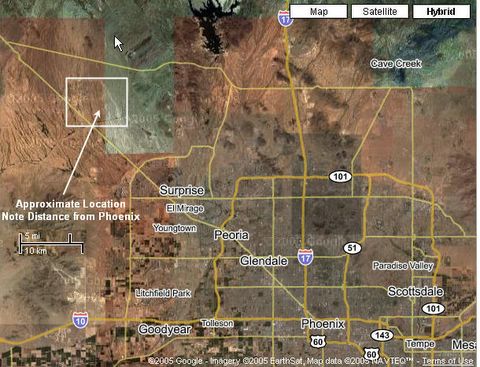


It seems to be about 35 or 40 miles away from Phoenix.
The attraction? A commute from there to downtown during rush hour might be close to an hour each way and where will gas prices be in a couple of years anyway?

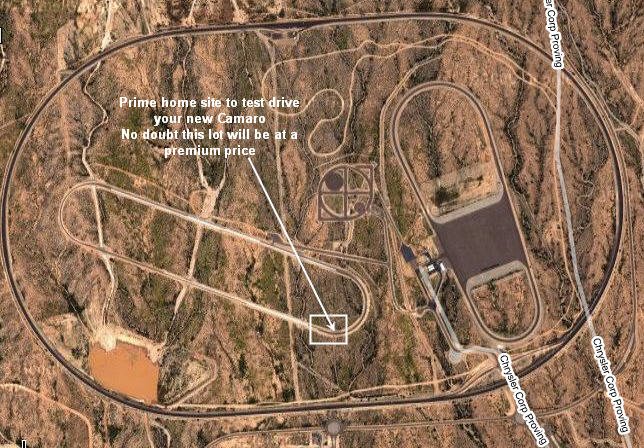
Let's zoom in looking for the attraction.


I do not see any do you?
Let's zoom in further.



There it is. I boxed it in. The premier spot to test drive your new Camaro, provided of course Toll Brothers decides to keep that test track up and running. If not, what the attraction?

Homebuilders Buried in Land

With that in mind, I note with interest this Street.Com article entitled Homebuilders Buried in Land. Enquiring Mish readers might want to know more so let's take a look at that too.
Ed Wachenheim, a long-term value investor, agrees with the general view that homebuilder stocks are cheap right now. But the money manager, who was once a major owner of the sector, has sold off most of his positions because he's worried about the huge amount of land on builders' books.

"My fear is that many of the companies took on too-large land positions at too-high prices. And that means that should the industry turn down that there is risk that there will be some impairment of land values," says Wachenheim, who runs Greenhaven Associates, a Purchase, N.Y.-based firm that manages $3.7 billion of capital, mostly for wealthy individuals.

It's difficult to determine if Wachenheim's concerns are justified and builders have been too aggressive in taking on new land. Builders report the dollar value of their total land holdings in quarterly filings, but nothing is usually said about the prices paid for individual parcels.

There also is no geographic breakdown to determine whether a builder like Pulte Homes has too much exposure to a frothy market like Las Vegas. All the public knows is that Pulte's total inventory of owned land was $5.3 billion for the quarter ending Sept. 30, up from $4.49 billion a year earlier. That amounts to 170,000 home lots, or roughly three years of supply, the company says.

But what if that's too much land to be holding in a slowing housing market?
The issue is of particular note since builders have spent the bulk of their earnings over the past few years buying land for future building. Although most builders have at least 50% of their lots controlled through options, a large amount of purchased land continues to be placed on balance sheets. As a result, the sector in general has seen negative cash flows for some time now.

"I have never seen a group, in 20 years of analysis, post negative cash flow from earnings for four of the last five years and prosper as a stock group without having to pay the piper," says Jim Poyner, an analyst for Palladian Research, an independent New York research house. Poyner thinks land impairments could begin popping up over the next year if builders start slashing prices on new homes for sale.

Robert Curran, a Fitch Ratings analyst who covers the builders, says it's premature to worry about land impairments now, but grants that the issue could arise in the future.

"There isn't anyone who really stands out as being overloaded on raw land on the balance sheet that is just sitting there," Curran says. It would take an economic recession or a really problematic regional housing market for there to be large land impairments, he adds. "If home prices come down, it doesn't mean you will write down land assets."
Another Telepathic Question

On that thought I just received another telepathic question. It's been a while since we have had one of those and here it is: "But Mish what about those fabulous PEs?"

Those PEs are a mirage. The homebuilders have negative cash flow and keep sinking every penny of their earnings into land, land, and more land at increasingly absurd prices as the article above addressed, and that transaction proved.

Here is the homebuilder picture:
  • Homebuilders have negative cash flows
  • Homebuilders put the bulk of their profits into buying more land at absurd prices
  • Homebuilders are totally ignoring the yield curve
  • Homebuilders are discounting the odds of a recession
That of course does not mean that homebuilders will sink anytime soon. They may or they may not. There has been one hell of a short squeeze lately and everyone seems to be playing the trend of 2003 right now. No one seems to see falling sales, rising inventories, sinking refis, and discounts by the home builders.

Just two weeks ago I was told by a Real Estate Broker friend of mine that Atlanta was impervious to a slowdown and there would be no recession coming our way. I note with interest This ad by Centrex.

$60,000 off?
Everything is fine in Atlanta?

Everyone seems to think their area is impervious to a slowdown because of demographics, warm weather, an ocean, or whatever. That seems to be the key to this mania.

Well I have news for you.
An Interest Rate Squeeze does not care where you live. Prices matter as do prevailing rents. Home prices do not always go up. Please click on that link and see what I am talking about. I suspect Toll Brothers and Meritage Homes will find out in due time just how silly that purchase in Phoenix was. By then it will be too late. It is the overpayment for land that bankrupts homebuilders every cycle. This cycle will be no different.

Mish note: This article originally appeared in Whiskey and Gunpowder.
Following are three comments I received in response to that publication:

From: Connie
Subject: Phoenix real estate - I live here!!

I live in the east valley of Phoenix, and I can tell you things are really slowing down here, as existing homes are sitting unsold for weeks now and prices are dropping. I am planning to leave the area soon because there will not be any water here in the coming years and it will be a MAMMOTH problem. No one seems to care now but it is coming! I have been called numerous times to come to an opening of Dell Webb new project. I think they are having trouble getting interest in it and they keep saying they "haven't decided on prices yet" so what's up with that? Keep up the good work,

C.J. Phoenix, AZ
==================================================
Subject: $312 million for that?

Why buy land for housing development? They should've invested in a tract of mineral rich land in Nevada. At least when the housing market implodes they could start mining for gold, or sell it on to one of the big resource hungry blue chips. Or is there actually precious yellow metal under that ground they purchased near Phoenix that no-one is aware of?

Regards,
J.N.
==================================================
Subject: Phoenix Desert

Hi There,

You missed a major point. Where are they going to get the water for all those houses? The Colorado River is over subscribed. One of the worst droughts in history is going on there in Arizona right now. And those of us up here in the Rust Belt just cemented a deal so they cannot steal water from the Great Lakes. Oh well, in 20 years it will all be part of Mexico once again, anyway.
Keep up the great work!

S.B.
==================================================

Mike Shedlock / Mish
http://globaleconomicanalysis.blogspot.com/

Wednesday, January 18, 2006

Cheaper Than a Condo

Once again Taschen goes over the top, this time with Richard Meier.

Missing image - taschen-meier.jpg

This Artist's Limited Edition (100 copies worldwide, including a signed and numbered print) is a steal at only $1500...well, it's a steal compared to a multi-million dollar condo in one of his Perry Street towers.

(Thanks again to Jeff S. for feeding me the good stuff)

Books of the Moment

Taschen is set to publish four books in its Contemporary Architecture by Country series: Switzerland, Japan, Netherlands, and United Kingdom in April. Like the publisher's other architecture titles, such as the Architecture Now! series, these promise to be full of delectable eye candy.

Missing image - taschen4.jpg

(via dezain)

Tuesday, January 17, 2006

Bankruptcy Law Backfires Already

The Washington Post is reporting Bankruptcy Counseling Law Doesn't Deter Filings.
Three months after a new bankruptcy law took effect, the overwhelming majority of debtors seen by credit counseling agencies are filing for bankruptcy instead of using repayment plans envisioned by the law's supporters.

The law requires debtors to see credit counselors before they file for bankruptcy protection. It is a prerequisite that banks and credit card issuers hoped would steer consumers away from bankruptcy court and into plans that would allow them to repay debts over a few years.

But so far, that is not happening.

The counseling agencies say most debtors are in such deep financial trouble that they cannot qualify for a debt-management plan.

"Typically, consumers are too far gone when they get to us," said Ivan L. Hand Jr., president and chief executive of Money Management International Inc. (MMI), the nation's largest credit-counseling organization.

That was true during an afternoon spent with MMI credit counselor Lynn Cameron as she advised consumers from a small, gray cubicle in a 150-operator call center in Phoenix last month.

"Bankruptcy is about the only option," Cameron told a Colorado couple whose home was about to be foreclosed upon.

"It doesn't look like you have any alternative at this point," she said on her next call -- with a Maryland family of four with more than $59,000 in credit card debt.

"Bankruptcy looks like a very good option," she repeated an hour later to a disabled 60-year-old with no income and no assets but lots of debts.

In the first 13 weeks after the new law took effect Oct. 17, only 4.5 percent of the 14,907 debtors counseled by MMI had sufficient income to be considered for a plan to pay back debts over a few years. Of those 669 debtors, only 42 have signed up so far for such a debt-management plan.

Financial industry executives, who had pushed for the new law to reduce the record number of bankruptcy cases, say it is too early to tell how well the new credit-counseling requirement is working -- especially because so many consumers rushed to file under the old, less-restrictive law. In the two weeks before the new law took effect, more than 600,000 debtors filed for protection from creditors.

Previously, filings had averaged about 30,000 a week. The number dropped to about 3,600 a week right after the new law took effect, but is now about 5,000 a week and is expected to climb as holiday bills come due.

Credit-counseling executives expect the number of bankruptcy filings to pick up in the next few months, the traditional peak period for credit counseling, as families cope with increased energy prices, higher interest rates and a new federally mandated policy that boosts the minimum amount due on monthly credit card bills.
Key findings:
  • Only 4.5 percent of the 14,907 debtors counseled by MMI had sufficient income to be considered for a plan to pay back debts over a few years. Of those 669 debtors, only 42 have signed up so far for such a debt-management plan.
  • In the two weeks before the new law took effect, more than 600,000 debtors filed for protection from creditors.
  • Previously, filings had averaged about 30,000 a week. The number dropped to about 3,600 a week right after the new law took effect, but is now about 5,000 a week and is expected to climb as holiday bills come due.
Let's see 42 out of 14,907 filings opted for debt management. That is a fine success ratio of .28%. Yes that decimal point is in the right place. The industry got what it wanted.

At the time I proposed it would backfire. The way to get around the means test is to be incredibly in debt and or lose a job and or be so far under that bankruptcy is the only option. That means test will likely ENSURE that those filing wait until they are damn sure they can not possibly meet the means test, racking up more bills in the meantime.

Those few that do opt into a pay back plan will be all the more careful to never rack up credit card debt again, barring of course a medical disaster or other emergency. This bill, designed to make people debt slaves forever, was doomed from the start.

Everyone seemed to expect bankruptcies to fall off a cliff after the October dealine under the old rules. Well the number initially plunged but comparing the rate to a period right after Katrina and right before a legal change is not exactly right. The important point is that it only took a few weeks for the rate to rise from 3,600 a week to 5,000 a week.

That is a lot of distress.
And I confidently predict it will get a lot worse too.
Following is just one reason:

The Orange County Register is reporting late property tax payments.
A yellow warning light is shining on the Orange County real estate market's dashboard. The number of delinquent property tax payments has reached the highest level in a decade.

This worrisome trend may be evidence that high purchase prices and burgeoning payments on popular adjustable mortgages as interest rates rise may finally be taking a toll on the budgets of local property homeowners.

Orange County's tax collector reports that:

Almost 46,000 property owners had not paid as of Jan. 7, a group that's grown 15 percent from the same time a year ago. It's also the largest count since the December 1995 bill.

These laggards - equal to 5.6 percent of all taxpayers - include residential and commercial property owners. Late payers owe $83 million to the county government- a sharp 35 percent jump in late bills from 2005. That overdue sum equals 4.3 percent of the total tax dollars owed.
The OC Register was a little more sanguine about those numbers than I am. With rising home prices homeowners had an option of taking out a line of credit or doing a cash out refi to pay taxes. Not any more. The gig is up, prices are falling and builders are offering massive reductions. Poof, entire neighborhoods are being repriced down by as much as $100,000 as noted in Centex "One Day" Sales.

Does anyone think those are "one day" sales?
Not me. Check out the Inman News January report card:

"There are now nearly 200,000 more unsold new homes under construction than there were just five years ago. Rapidly rising sales have masked the surge in construction. Most analysts focus on the months of new-home supply, which is shown below. Since hitting a low of 3.5 months of supply in the summer of 2003, this number has gradually increased to its current value of 4.9 months, its highest value since December 1996. While 4.9 months of supply is not concerning because the figure remains so low by historical standards, the months of supply calculation is held down by the high level of sales. If sales slow even a little, the months of supply figure will surge, as it did in 1990. The total number of unsold new homes is shown in the purple line below. There were 503,000 unsold new homes in November 2005, compared with 305,000 in November 2000."

Here is the lethal mix:
  • Home inventory dramatically rising
  • Home prices falling
  • Credit standards tightening
  • Interest rates still rising
  • Global economy peaking
  • Real wages falling
There is every reason to think that the tidal wave of bankruptcies is just beginning.

Mike Shedlock / Mish
http://globaleconomicanalysis.blogspot.com/

Red Berghoff

In the Sun-Times today, David Roeder has a good piece about the GSA's interest in the Berghoff property, bringing into question the circumstances behind the family's closing of the restaurant (set for February 28). Beyond that unofficial speculation, the article tries to illuminate the city's landmark policy, which rated close to 10,000 buildings in the city about a decade ago (transcribed below). Note: these ratings are separate from official Chicago landmarks.
WHAT COLOR IS A SHADOW LANDMARK?

The City of Chicago developed a kind of shadow landmark system by color-coding buildings that might have architectural or historic importance. A shadow designation is easier to impose than official landmark status. The highest ratings are red and orange. Any attempt to demolish a red- or orange-rated building triggers a 90-day hold on permits while city employees determine whether the property should be saved.

RED BUILDINGS
Red buildings have the highest ratings. There are 171 red buildings in Chicago, of which 140 are official landmarks.
Examples include:
Carson Pirie Scott store, 1 S. State
City landmark? Yes
Wrigley Building, 410 N. Michigan
City landmark? No
Merchandise Mart, 222 Merchandise Mart Plaza
City landmark? No
Rookery Building, 209 S. La Salle
City landmark? Yes
Marshall Field, 111 N. State
City landmark? No

ORANGE BUILDINGS
Orange buildings are deemed slightly less significant than red buildings. About 9,600 properties carry the designation. Few are city landmarks, but many are within landmark districts, thus limiting an owner's right to alter or raze them.
Examples include:
Oriental Theatre, 32 W. Randolph
City landmark? No
Palmer House, 17 E. Monroe
City landmark? No
Holy Name Cathedral, 735 N. State
City landmark? No
Drake Hotel, 140 E. Walton
City landmark? Yes
Chicago Daily News building, 400 W. Madison
City landmark? No

RETAILING LANDMARKS?
Both the Marshall Field's and Carson Pirie Scott stores are Chicago icons and designated "red" buildings. One is a landmark and one isn't.
But as we can see by the city's recent behavior (PDF link), these colored designations can sometimes lose their meaning and purpose.
 
Copyright 2010 Camera Dashboard. All rights reserved.
Themes by Ex Templates Blogger Templates l Home Recordings l Studio Rekaman